
French ironclad Normandie
1860 Gloire-class ironclad
Vessel Wikidata
* This information from Wikidata is available under the Creative Commons Attribution-ShareAlike License
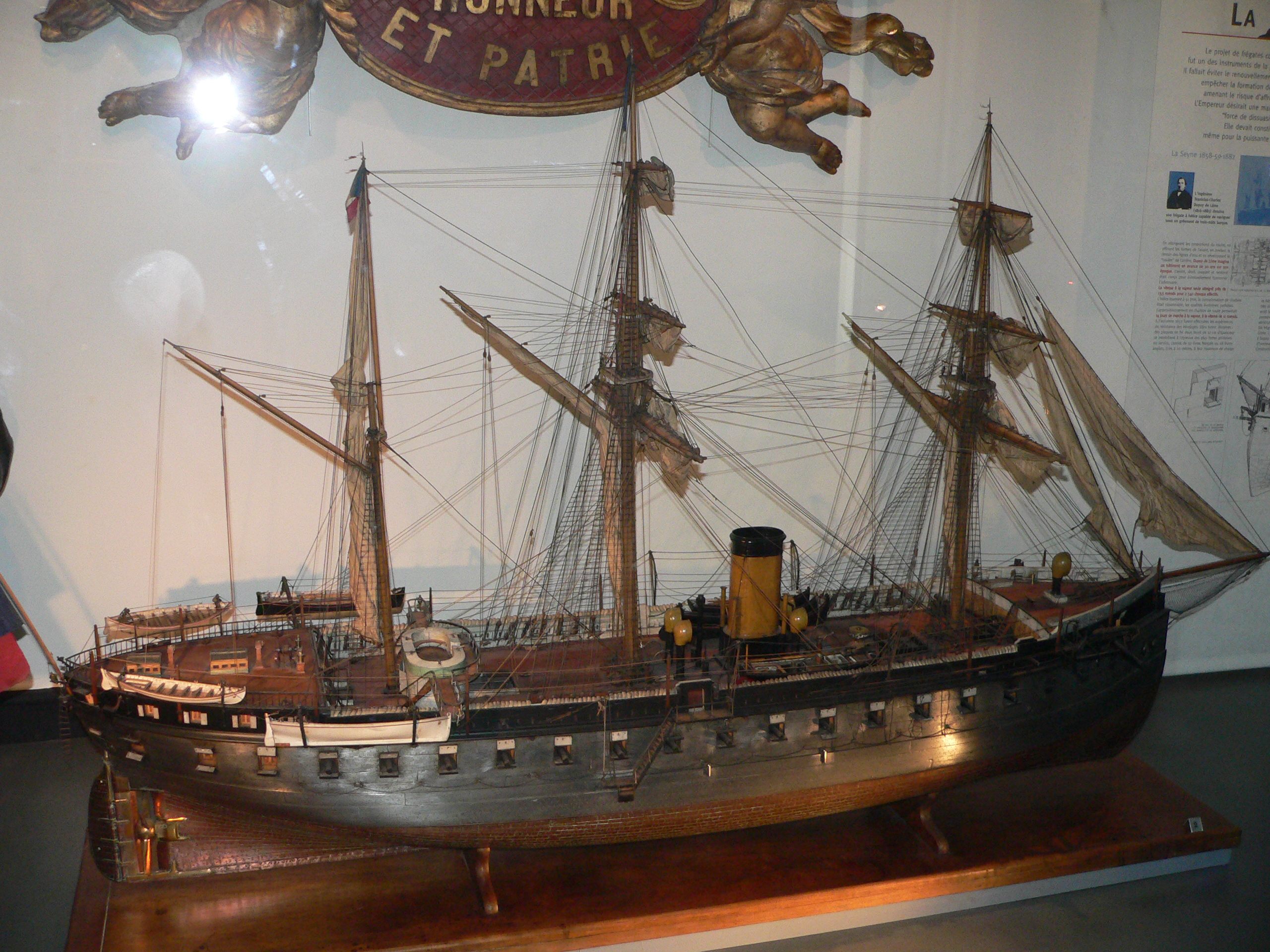
The French ironclad Normandie was the third and final vessel of the Gloire-class, a group of wooden-hulled armoured frigates built for the French Navy between 1858 and 1862. Designed by Henri Dupuy de Lôme, she measured 77.25 meters (253 feet 5 inches) in length with a beam of 17 meters (55 feet 9 inches) and a maximum draft of 8.48 meters (27 feet 10 inches). Displacing approximately 5,650 tonnes, her hull featured a wrought iron armor belt 120 millimeters (4.7 inches) thick that extended 5.4 meters (17 feet 9 inches) above and 2 meters (6 feet 7 inches) below the waterline, providing significant protection for her time. The hull was constructed of unseasoned timber, which proved to be a critical weakness. Normandie was powered by a horizontal return connecting-rod compound steam engine, driving a single propeller, with eight Indret oval boilers supplying steam. Her engine produced up to 2,500 indicated horsepower, allowing her to reach a top speed of around 8 knots. She carried 675 tonnes of coal, enabling a range of approximately 4,000 kilometers (2,500 miles). Initially rigged with a light barquentine sail plan, her sails were later replaced with a full ship rig, which was eventually reduced due to excessive rolling. Her armament consisted of 36 Modèle 1858 164.7-millimeter broadside guns, later upgraded to rifled breech-loading Modèle 1864 guns, along with additional guns on the upper deck. Normandie’s notable service includes being the first ironclad to cross the Atlantic in support of the French intervention in Mexico in 1862, serving as Vice Admiral Edmond Jurien de La Gravière’s flagship. She made a port visit to Brest in 1865 and participated in diplomatic visits to Portsmouth. During the Franco-Prussian War, she was part of the ironclad squadron but saw no combat. After the war, her unseasoned timber hull deteriorated rapidly, leading to her decommissioning in 1871, and she was subsequently scrapped. Her engine was repurposed for the monitor Tonnerre, marking her as a significant but short-lived part of French naval history.
This description has been generated using GPT-4.1-NANO based on the Vessel's wikidata information and then modified by ShipIndex.org staff.