
SS Choctaw
unique semi-whaleback steamship ship wrecked in Lake Huron in 1915

Vessel Wikidata
* This information from Wikidata is available under the Creative Commons Attribution-ShareAlike License
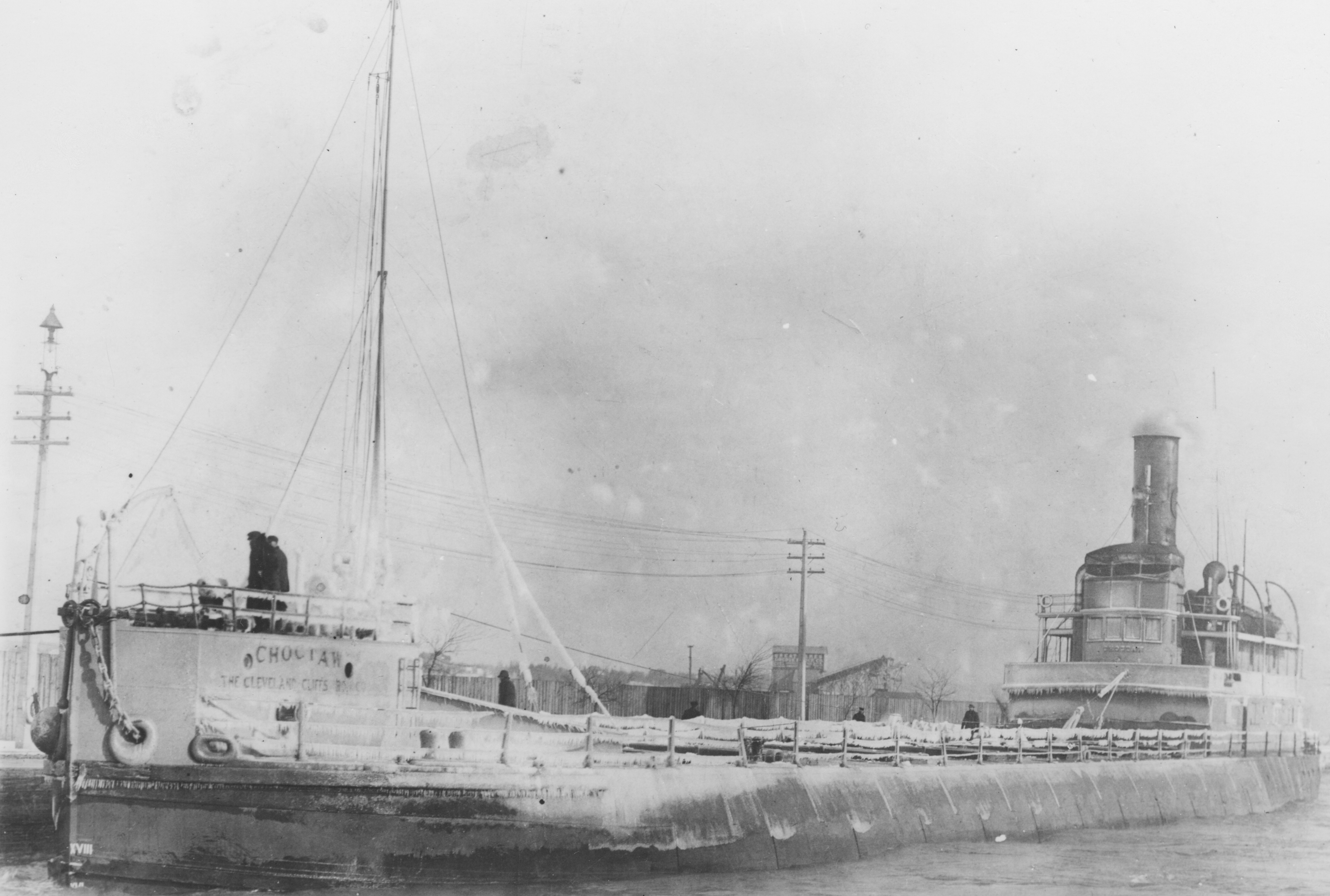
The SS Choctaw was a distinctive steel-hulled American freighter that operated on the Great Lakes from 1892 until her sinking in 1915. Built by the Cleveland Shipbuilding Company in Cleveland, Ohio, she measured approximately 266.9 feet (81.4 meters) in length with a beam of 38.1 feet (11.6 meters). Her hold was 17.9 feet (5.5 meters) deep, capable of carrying up to 2,800 short tons (2,500 tons) of cargo, primarily iron ore and coal, reflecting her role in the booming iron ore trade of the late 19th and early 20th centuries. Her gross register tonnage was about 1,574 tons, with a net tonnage of roughly 1,256 tons. She was powered by a 900-horsepower triple expansion steam engine fueled by two coal-fired Scotch marine boilers. Design-wise, Choctaw was a semi-whaleback vessel, a hybrid that combined elements of traditional lake freighters with the innovative whaleback ships designed by Alexander McDougall. She featured straight sides with inward-sloping "tumblehome" sides from the waterline upward, a design created by Swedish naval architect Arendt Ångström. She had a cutaway stern and seven cargo hatches, with no interior bulkheads between her collision bulkhead and stern engine bulkhead. Her unique monitor-like design, with a high-visibility profile and straight sides, made her one of only three ships of this type ever built. Throughout her service, Choctaw faced several incidents, including a collision in 1896 that caused her to sink temporarily and multiple groundings. She was involved in the 1913 Great Lakes Storm, during which she was in Marquette Harbor. Her most notable event occurred on July 11, 1915, when she was struck and sank within 17 minutes after a collision with the Canadian canaller Wahcondah in foggy conditions on Lake Huron. Despite the rapid sinking, all 22 crew members escaped unharmed. Her wreck was discovered in 2017 at a depth of approximately 300 feet (91 meters), resting on her starboard side with the bow partially buried, making her a highly sought-after archaeological site. The wreck's preservation and unique design contribute significantly to maritime history, and she was listed on the National Register of Historic Places in 2018. The Choctaw remains a notable example of early steel lake freighters and semi-whaleback design innovation.
This description has been generated using GPT-4.1-NANO based on the Vessel's wikidata information and then modified by ShipIndex.org staff.