
HMS Wallaroo
1890 Pearl-class cruiser
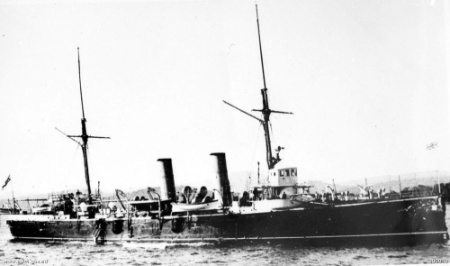
Vessel Wikidata
* This information from Wikidata is available under the Creative Commons Attribution-ShareAlike License
HMS Wallaroo was a Pearl-class cruiser constructed for the Royal Navy, originally launched as HMS Persian on 5 February 1890 by Armstrong, Mitchell, Elswick in Newcastle upon Tyne. Soon after her launch, she was renamed HMS Wallaroo on 2 April 1890 to serve as part of the Auxiliary Squadron of the Australia Station. The vessel's physical specifications are not detailed in the provided content, but as a Pearl-class cruiser, she would have been designed for patrol and escort duties typical of the class. The ship arrived in Sydney with the squadron on 5 September 1891 and was placed into reserve until 9 May 1894. She played a notable role during the Boxer Rebellion in 1900, serving in China. During her service, she experienced a significant incident on 6 January 1904, off Montague Island, when a boiler explosion resulted in the deaths of four crew members and injuries to three others. HMS Wallaroo left the Australia Station on 11 January 1906 and was subsequently assigned as a training ship for mechanics at Devonport, attached to HMS Indus. Her role shifted again in November 1914, when she became a guard ship at Chatham. During World War I, she was stationed off Brightlingsea, Essex, serving as the base ship for the boom and net-protected Swin Anchorage. She returned to Chatham in 1916. During this period, her commanding officers included Commanders Calderon, Ingham, and West, under the overall command of Rear-Admiral Charles Napier, who also named the naval base "Wallaroo." The vessel was often overflown by Zeppelins, and notably, she once fired on one during her service. In March 1919, she was renamed HMS Wallington and was sold in 1920 to G. Sharpe for breaking up. Throughout her career, HMS Wallaroo served in various capacities, from colonial patrols to wartime guard duties, and her service reflects the Royal Navy's global reach and evolving maritime security roles in the late 19th and early 20th centuries.
This description has been generated using GPT-4.1-NANO based on the Vessel's wikidata information and then modified by ShipIndex.org staff.