
SMS Leopard
1885 Panther-class protected cruiser
Vessel Wikidata
* This information from Wikidata is available under the Creative Commons Attribution-ShareAlike License
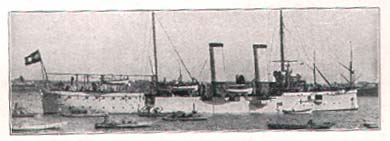
SMS Leopard was a notable torpedo cruiser of the Austro-Hungarian Navy, constructed in Britain at the Armstrong shipyard in Elswick. Laid down in January 1885, she was launched on September 10, 1885, and completed by March 1886. The vessel measured approximately 73.19 meters (240 feet 1 inch) in length, with a beam of 10.39 meters (34 feet 1 inch) and a draft of 4.28 meters (14 feet 1 inch). Displacing around 1,557 long tons at normal load, Leopard featured a minimal superstructure with a small forward conning tower, an inverted bow, and a forecastle deck extending about a third of her length. She was crewed by 186 officers and men. Propulsion was provided by two vertical compound steam engines, turning two screw propellers, powered by six cylindrical fire-tube boilers funneling steam through two stacks. On trials, she achieved a top speed of 18.7 knots, with a cruising radius of approximately 2,800 nautical miles at 10 knots. Her armament included two 12 cm (4.7-inch) guns in sponsons amidships, supported by four 47 mm quick-firing guns and six 47 mm revolver cannons for close-range defense. Her offensive capability was centered on four 14-inch (356 mm) torpedo tubes, placed singly at the bow, stern, and on either beam. She had a thin 12 mm armored deck for protection. Leopard's service history was diverse. Early on, she participated in fleet maneuvers and represented Austria-Hungary at the 1888 Barcelona Universal Exposition. She also took part in international naval demonstrations off Crete during the Greco-Turkish War in 1897. Notably, she embarked on a Pacific Ocean tour from 1900 to 1901 and served in the East Asia squadron from 1907 to 1909, visiting ports across China, Russia, and Japan. The ship underwent modernization in 1910, rearming with lighter guns before being decommissioned in May 1914. Reactivated during World War I, she served as a harbor guard ship in Pola throughout the conflict. Following Austria-Hungary's defeat, Leopard was ceded to Britain as a war prize but was ultimately sold for scrap in Italy in 1920. Her career highlights include her role in international diplomacy, naval demonstrations, and peacetime deployments, reflecting Austria-Hungary’s efforts to bolster its naval capabilities during the late 19th and early 20th centuries.
This description has been generated using GPT-4.1-NANO based on the Vessel's wikidata information and then modified by ShipIndex.org staff.