
HMS Belleisle
1794 Téméraire-class third-rate ship of the line
Vessel Wikidata
* This information from Wikidata is available under the Creative Commons Attribution-ShareAlike License
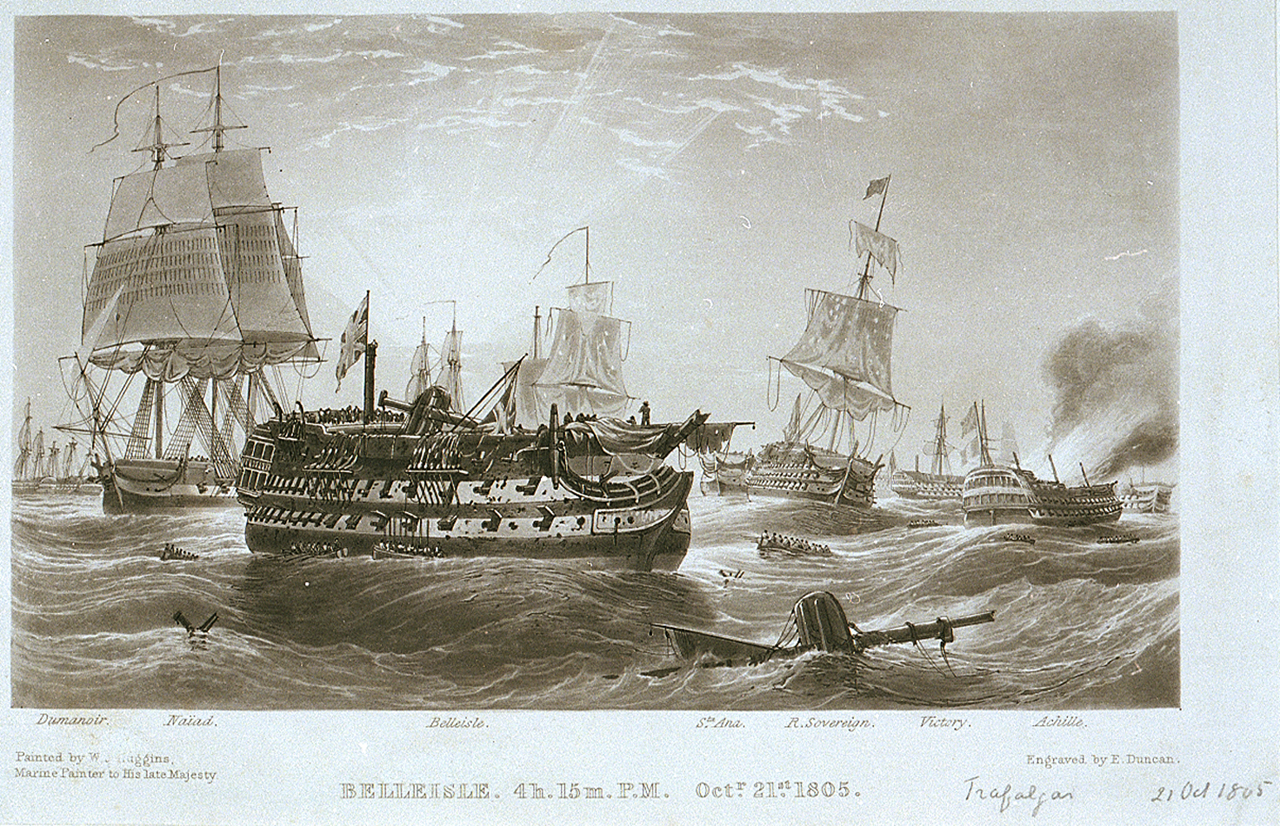
HMS Belleisle was a 74-gun Téméraire-class ship of the line that served prominently in the Royal Navy during the late 18th and early 19th centuries. Originally constructed for the French Navy, she was built at Rochefort between August 1791 and June 1794. Throughout her early career, she underwent multiple name changes, initially being named Lion in 1790, then Marat in September 1793, and finally Formidable in May 1795, reflecting the tumultuous political climate of the French Revolution. The vessel participated in notable engagements such as the action of 6 November 1794, where she successfully raked HMS Alexander. During the Battle of Groix on 23 June 1795, she fought under Captain Linois and was captured by HMS Barfleur near Lorient. Transferred to the Royal Navy, she was renamed Belleisle—likely due to confusion over her origin, mistakenly believed to be captured off Belle Île rather than Groix. As part of the Royal Navy, HMS Belleisle played a significant role in the Battle of Trafalgar in 1805. She served as the second ship in the British lee column under Captain William Hargood. During the battle, she was heavily engaged with Franco-Spanish ships including Achille, Aigle, Neptune, Fougueux, Santa Ana, Monarca, and San Juan Nepomuceno. She was the only British ship to become completely dismasted, rendering her largely immobile and unable to manœuvre, with her sails obstructing her batteries. Despite this, she maintained her flag for 45 minutes until rescue by ships behind her. The battle left her with 33 dead and 93 wounded, and she was subsequently towed to Gibraltar by HMS Naiad. Later, HMS Belleisle served as the flagship of Rear-Admiral Alexander Cochrane during operations in the Danish West Indies, capturing several vessels in April 1807. The ship remained in service until 1814, when she was decommissioned and broken up at Portsmouth. Her career highlights her resilience and importance in key naval battles and colonial operations during the Napoleonic era.
This description has been generated using GPT-4.1-NANO based on the Vessel's wikidata information and then modified by ShipIndex.org staff.