
USS Argonaut
1927 V-boat
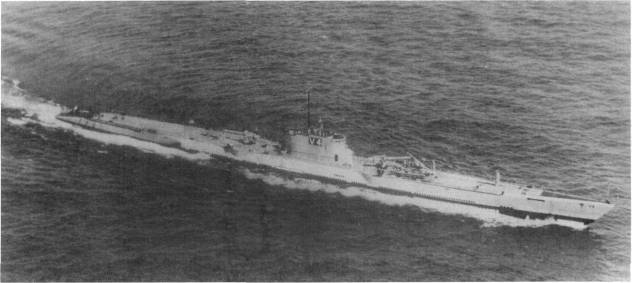
Vessel Wikidata
* This information from Wikidata is available under the Creative Commons Attribution-ShareAlike License
The USS Argonaut (V-4/SF-7/SM-1/A-1/APS-1/SS-166) was a pioneering United States Navy submarine, notable for its size, versatility, and strategic role during the interwar period and World War II. Laid down on 1 May 1925 at Portsmouth Navy Yard and launched on 10 November 1927, she was commissioned on 2 April 1928. Although she was never officially designated SS-166, she bore this number at times on her conning tower. She was the first of the second-generation V-boats, and at her time of construction, was the largest submarine ever built in the U.S., a distinction she held for three decades. Constructed primarily as a minelayer, USS Argonaut featured a complex internal arrangement with four torpedo tubes forward and two specialized minelaying tubes aft, capable of deploying mines via hydraulically operated sliding doors. Her design incorporated ingenious but complicated mine storage and deployment systems, including a compensating tube to balance the weight of laid mines. Her hull was built using a mixed construction technique, combining riveted and welded sections, with welding introduced during her assembly at Portsmouth, marking a significant development in U.S. submarine construction. Powering her were two MAN-designed diesel engines initially, but due to technical issues, she was ultimately equipped with smaller, reliable MAN diesels producing 1,400 hp each. She also featured an upgraded battery system with 120-cell batteries, enhancing her submerged endurance. Her dimensions and slow diving capabilities, however, made her unwieldy and vulnerable to enemy sonar. Throughout her career, USS Argonaut served in various roles, including minelaying, patrols, and troop transport. She participated in notable operations such as the Makin Raid in August 1942, transporting Marine Raiders to the Gilbert Islands. She was later converted into a transport submarine and operated in the South Pacific from Brisbane, Queensland. Her final patrol led to her sinking on 10 January 1943 near Rabaul after engaging a Japanese convoy. Damaged by depth charges and gunfire from Japanese destroyers, she sank with the loss of 102 crew members, marking the greatest wartime loss of an American submarine. Her bell remains a memorial at Pearl Harbor, symbolizing her service and sacrifice.
This description has been generated using GPT-4.1-NANO based on the Vessel's wikidata information and then modified by ShipIndex.org staff.