
HMS Cumberland
1842 Cumberland-class third-rate ship of the line
Vessel Wikidata
* This information from Wikidata is available under the Creative Commons Attribution-ShareAlike License
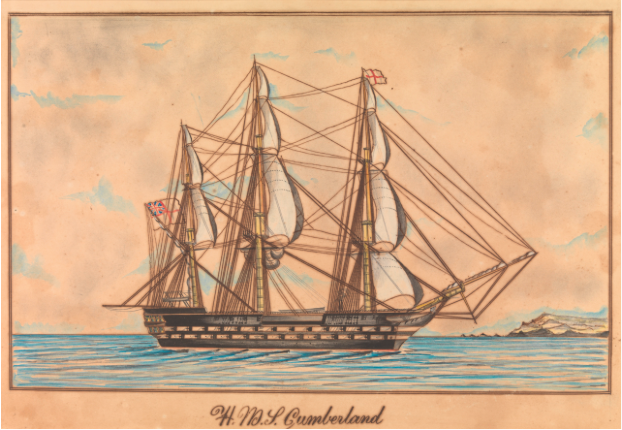
HMS Cumberland was a 70-gun third-rate ship of the line of the Royal Navy, launched on 21 October 1842 at Chatham Dockyard. As a vessel of considerable firepower for its class, Cumberland served as a significant component of Britain’s naval forces in the mid-19th century. She was crewed by approximately 620 men, reflecting its status as a formidable warship of its era. Following her commissioning, Cumberland served as a flagship under Captain George Henry Seymour, commanding the vessel in the North America and West Indies Station. Her operational history includes participation in the Crimean War, where she was deployed to the Baltic Sea in March 1854 amidst rising tensions with Russia. Notably, she took part in the Battle of Bomarsund in August 1854, a joint Anglo-French attack targeting the fortress of Bomarsund in the Grand Duchy of Finland, marking her involvement in key military engagements of the period. In March 1858, Cumberland encountered a navigational mishap when she ran aground on an uncharted rock in the River Plate off Isla de Flores, Uruguay. Despite the incident, her captain and master were acquitted at a court martial held aboard HMS Impregnable in August of that year, indicating her seaworthiness and the professionalism of her crew. Later, in 1869, Cumberland was repurposed as a training ship for destitute and homeless boys from Glasgow, under the auspices of The Clyde Industrial Training Ship Association. Her role shifted from active combat vessel to social service, though her service was cut short when she was destroyed by an arson attack at Rhu on the Gareloch in Scotland in February 1889. She was subsequently replaced by HMS Revenge (1859), which was renamed HMS Empress, and continued her legacy as a training ship until her sale for scrap in 1923. Cumberland’s career reflects the transitional period of naval technology and the evolving roles of ships of the line in maritime history.
This description has been generated using GPT-4.1-NANO based on the Vessel's wikidata information and then modified by ShipIndex.org staff.