
HMS Defiance
ship of the line of the Royal Navy
Vessel Wikidata
* This information from Wikidata is available under the Creative Commons Attribution-ShareAlike License
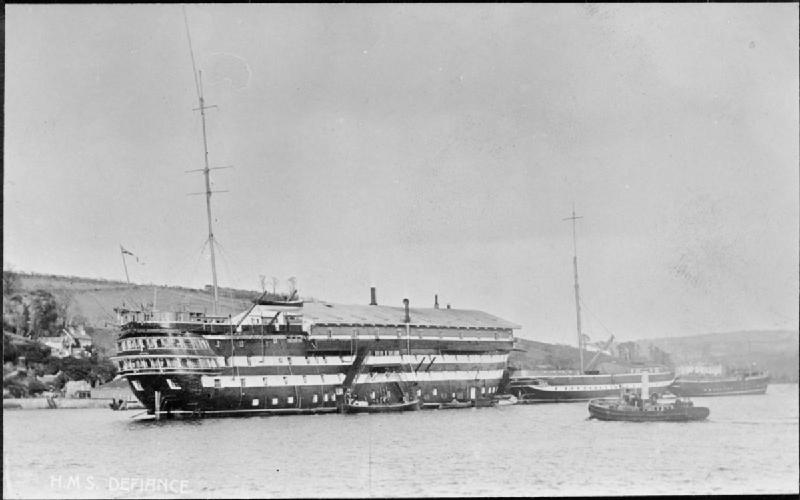
HMS Defiance, launched in 1861, holds the distinction of being the last wooden line-of-battle ship constructed for the Royal Navy. This vessel was a development of the Renown class, with design modifications that included a lengthened bow based on a new plan prepared on 8 October 1858. Originally, Defiance was laid down according to the same blueprint as HMS Atlas, one of the second pair of Renowns, but the design was altered to improve her lines. She was also the final ship to employ the midsection design created by Isaac Watts for HMS James Watt. Constructed as a wooden sailing ship, Defiance was notable for her size and intended role as a powerful warship. Her trial runs off Plymouth on 5 February 1862, conducted without masts or stores, recorded a speed of approximately 11.89 knots. This was slower than her sister ships Atlas and Anson, which achieved speeds around 13 knots, but given her lack of active sea service, the true performance potential remains uncertain. Despite her initial role as a line-of-battle ship, Defiance never served in this capacity. Instead, she was repurposed on 26 November 1884 as a school ship at Devonport, dedicated to torpedo and mining training. During her service as a training vessel, she contributed to significant experimental work; notably, in 1895, under Captain H.B. Jackson, she was involved in pioneering wireless transmission experiments that paved the way for wireless telegraphy in the Royal Navy. Throughout the early 20th century, Defiance remained an important training platform. A dedicated railway station, "Defiance Platform," facilitated personnel transport from 1905 until 1930. She was finally sold for dismantling on 26 June 1931 to Castle’s Shipbreaking Yard at Millbay, Plymouth. By then, she was regarded as the last of England’s historic 'Wooden Walls,' with her timbers and structural elements, including oak pillars and decking, being repurposed in local buildings, such as Furzehatt House in Plymstock. Her legacy marks the end of an era in wooden naval architecture and maritime history.
This description has been generated using GPT-4.1-NANO based on the Vessel's wikidata information and then modified by ShipIndex.org staff.