
HMS Leonidas
1913 Laforey-class destroyer
Vessel Wikidata
* This information from Wikidata is available under the Creative Commons Attribution-ShareAlike License
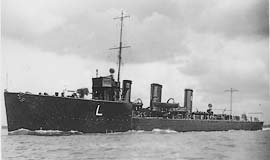
HMS Leonidas was a Laforey-class destroyer of the Royal Navy, launched on 30 October 1913. Originally named Rob Roy, her name was changed to align with a new naming scheme for ships of her class, which designated all vessels with names beginning with "L." The ship was constructed at a cost of approximately £100,000. As a notable experimental vessel, Leonidas was built alongside Lucifer as part of an effort to incorporate fully geared turbines, a technological advancement aimed at improving efficiency. The ship's propulsion system featured Parsons' innovative geared turbines, which allowed high-speed turbines to operate at higher rotational speeds, thus boosting overall efficiency. The design included high-pressure (HP) turbines running at 3000 rpm and low-pressure (LP) turbines at 1800 rpm, with gearboxes facilitating the transfer of power to the propellers rotating at a maximum of 380 rpm. This geared turbine system was expected to yield about a 10% efficiency gain, which translated into extended operational endurance—allowing Leonidas to remain on patrol for approximately two additional days compared to ships with conventional turbines. The gearboxes incorporated Michell tilting-pad fluid bearings, a significant technological development that mitigated the large lateral forces typical in turbine gearboxes and reduced frictional losses, ultimately saving the fleet substantial fuel costs. Leonidas's armament and design reflected the ongoing debate between naval authorities and Parsons regarding propeller blade area, with two different designs produced. The vessel was powered by a reduced horsepower of 22,500 shp, thanks to the efficiencies gained through gearing, compared to 24,500 shp for non-geared ships of her class. During her service in World War I, HMS Leonidas served with the 3rd Destroyer Flotilla, primarily as a convoy escort. Notably, she participated in the Battle off Noordhinder Bank on 1 May 1915, where she and other destroyers engaged German torpedo boats, resulting in the sinking of the German A6. She also took part in the First Battle of Heligoland Bight, contributing to significant naval engagements. The vessel was decommissioned and broken up in 1922, marking her brief but technologically significant service history.
This description has been generated using GPT-4.1-NANO based on the Vessel's wikidata information and then modified by ShipIndex.org staff.