
HMS Lowestoffe
1761 fifth-rate frigate
Vessel Wikidata
* This information from Wikidata is available under the Creative Commons Attribution-ShareAlike License
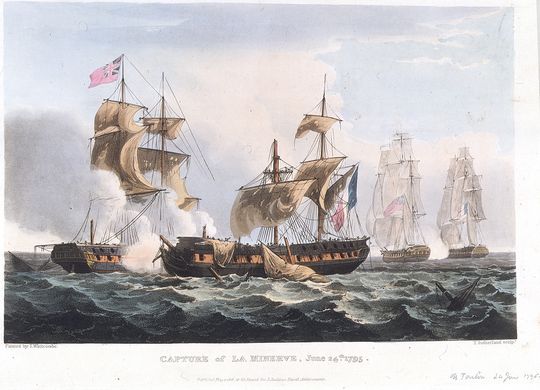
HMS Lowestoffe was a unique 32-gun fifth-rate frigate of the Royal Navy, constructed during the late years of the Seven Years' War. Designed by Sir Thomas Slade, her lines were based on captured French vessel Abenakise, and she was the only ship built to her specific design. Laid down at Deptford Dockyard on 9 May 1760 and launched on 5 June 1761, she was completed by 1 August 1761 at a cost of approximately £7,715, with additional funds spent on fitting out. Her initial service was in British waters, primarily patrolling and deterring illicit trade, with early deployments in the English Channel and the West Indies. She saw limited action during her first commission but was part of a squadron that seized several vessels near Dominica, sharing in prize money. After being paid off in 1762 and briefly recommissioned in 1763, she returned to the West Indies, operating under various captains, including James Baker and Joseph Norwood, and was later reduced to a 28-gun sixth-rate. Recommissioned in 1777 under Captain William Locker, Lowestoffe played a significant role in the American War of Independence, including at the Battle of San Fernando de Omoa. Notably, Horatio Nelson served aboard her as second lieutenant shortly after passing his lieutenant's examination. Her service included capturing numerous enemy vessels, such as American sloops and privateers, and participating in key actions like the attack on Fort San Fernandino de Omoa in 1779, during which she grounded but contributed to the engagement’s success. During the French Revolutionary Wars, Lowestoffe was active in the Mediterranean, supporting operations against French garrisons and engaging French ships. Her notable victory in June 1795 involved the capture of the French frigate Minerve after a fierce naval combat, earning her crew the Naval Gold Medal. She continued service in convoy escort duties in the West Indies until her final voyage in 1801. On 10 August 1801, while escorting a convoy in the Caicos Islands, Lowestoffe ran aground on Little Inagua Island amidst strong currents. Despite efforts to refloat her, she was wrecked, with only five men drowning during the incident. Her loss was attributed to a sudden change in the channel’s currents, and she was subsequently abandoned by her crew, who received salvage payments for her cargo. The vessel’s career highlights her as a versatile and active frigate, distinguished by her design, combat record, and service in multiple theaters of conflict.
This description has been generated using GPT-4.1-NANO based on the Vessel's wikidata information and then modified by ShipIndex.org staff.