
HMS Sultan
1870 ironclad
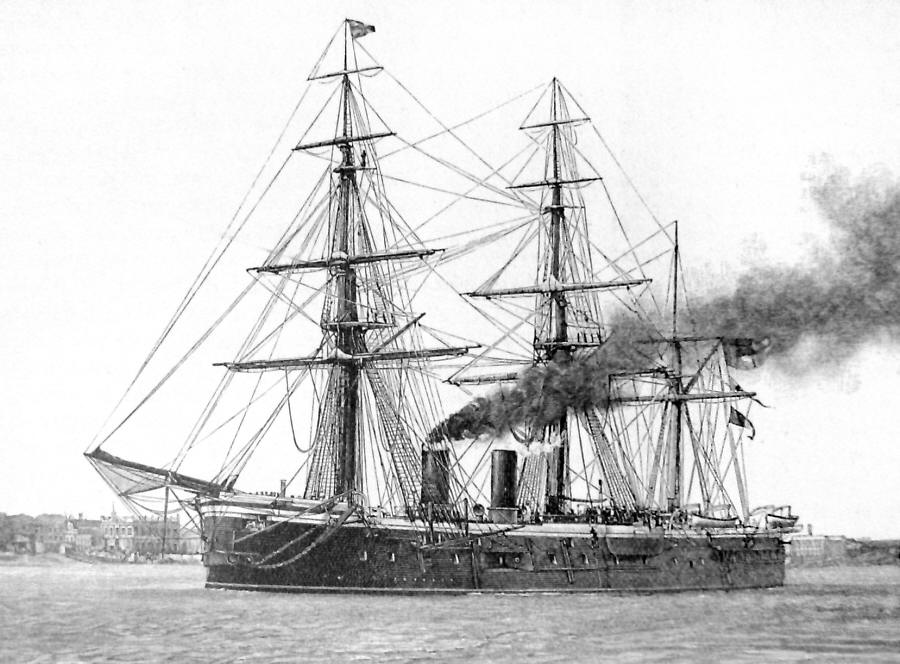
Vessel Wikidata
* This information from Wikidata is available under the Creative Commons Attribution-ShareAlike License
HMS Sultan was a Victorian-era broadside ironclad of the Royal Navy, notable for its central box battery armament and distinctive design features. Laid down during a period when naval architects were experimenting with turreted ships, Sultan was based closely on the design of HMS Hercules but featured a two-level main battery arrangement. Her main armament consisted of guns mounted on two levels: the lower deck provided broadside fire with limited forward capability, while the upper deck guns also contributed to broadside fire and could be aimed astern via traversing turntables. Constructed with a hull exhibiting one of the roundest amidships cross-sections of her time, Sultan was initially regarded as a stable gun platform, aided by her low metacentric height of only three feet. However, she was soon found to lack sufficient stability ("tender"), prompting the addition of approximately 600 tons of ballast within her double bottom. Commissioned at Chatham for service with the Channel Fleet, Sultan served until 1876 before undergoing refits that included reducing her rig to barque and deploying to the Mediterranean under the command of the Duke of Edinburgh. She participated in notable events such as the bombardment of Alexandria in 1882, where she sustained casualties from a single hit. Sultan also played a role during the Russian war scare of 1885, and her operational history included a collision with the French steamship Ville de Victoria in 1886, which resulted in the sinking of the latter. Her service was interrupted in 1889 when she grounded on an uncharted rock in the Comino Channel, ripping her bottom open. She was subsequently raised, repaired, and returned to Portsmouth in December 1889. Between 1892 and 1896, Sultan underwent a significant modernization, which included the addition of two tall funnels, a double bridge, new decks, and modern boilers and engines capable of speeds up to approximately 14.6 knots. Her armament was retained but reorganized, and her beam was increased to accommodate weight redistribution. Later, Sultan served as an artificers' training ship, a mechanical repair ship, and a depot ship during World War II before being sold in 1947. Her career reflects the transitional period of naval technology and the evolving role of ironclads in the Royal Navy.
This description has been generated using GPT-4.1-NANO based on the Vessel's wikidata information and then modified by ShipIndex.org staff.