
HMS Unicorn
1794 Pallas-class fifth-rate frigate
Vessel Wikidata
* This information from Wikidata is available under the Creative Commons Attribution-ShareAlike License
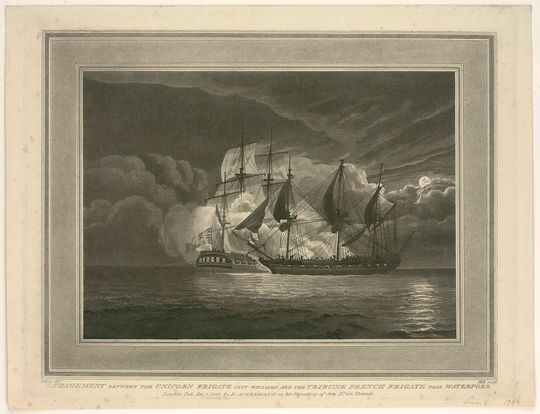
HMS Unicorn was a fifth-rate Pallas-class frigate of the Royal Navy, launched in 1794 at Chatham. She was armed with 32 guns, a typical complement for a frigate of her class, and served extensively during the French Revolutionary and Napoleonic Wars until her decommissioning and breaking up in 1815. Constructed with a length and beam consistent with Pallas-class specifications, Unicorn was designed for versatility and speed, enabling her to carry out a variety of missions including reconnaissance, escort, and combat. Early in her career, she was commanded by Captain William Cayley, and subsequently by Captain Thomas Williams, under whom she operated primarily in the Western Approaches from Cork. Unicorn's service record is marked by notable actions, including the capture of numerous enemy vessels. In 1795, she shared in the capture of the Dutch schooner Mary and, shortly afterward, with Diana and Seahorse, she captured the Dutch East Indiaman Cromhout, earning her significant prize money. Her pursuit of the Dutch brig Komeet resulted in her taking the vessel after a 13-hour chase; Komeet was well-armed with 18 guns and provisions for a nine-month cruise. Unicorn also recaptured the brig Thames and participated in various captures along the French and Dutch coasts. A key engagement occurred on 8 June 1796, when Unicorn engaged the French 44-gun frigate Tribune in a ten-hour running fight. Unicorn eventually captured Tribune after a 35-minute close-quarters combat, with her captain, William Williams, earning a knighthood for the victory. The action was recognized with the awarding of the NGSM clasp "Unicorn 8 June 1796" to survivors. Throughout her service, Unicorn participated in multiple fleet actions, including the Battle of Basque Roads in 1809, and was involved in capturing privateers, merchant vessels, and French ships. She also supported British invasions in South America and conducted patrols and blockades along the European coast. Under successive captains, she continued active service until her decommissioning in 1815, after which she was broken up at Deptford. Her career highlights her role as a versatile and active frigate in the Royal Navy during a period of intense maritime conflict.
This description has been generated using GPT-4.1-NANO based on the Vessel's wikidata information and then modified by ShipIndex.org staff.