
HMS Verulam
1943 V-class destroyer
Vessel Wikidata
* This information from Wikidata is available under the Creative Commons Attribution-ShareAlike License
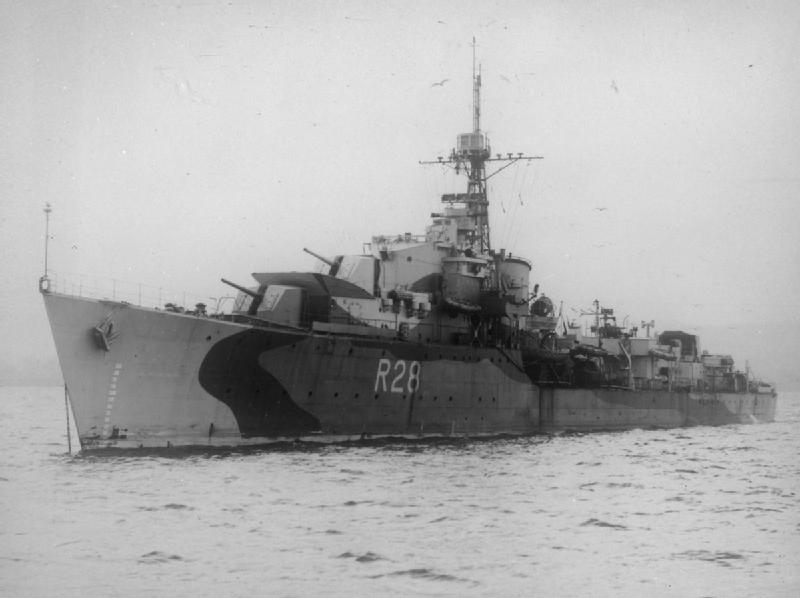
HMS Verulam (R28) was a V-class destroyer of the British Royal Navy, constructed during World War II as part of the 1941 War Construction Programme. Laid down at Fairfield's Govan shipyard in Glasgow on 26 January 1942, she was launched on 22 April 1943, and commissioned on 26 November 1943. She measured approximately 363 feet in length overall, with a beam of 35 feet 8 inches and a full load draught of 14 feet 3 inches. Displacing 1,808 long tons standard and 2,530 long tons at full load, Verulam was powered by two Admiralty 3-drum water-tube boilers and Parsons turbines, delivering 40,000 shaft horsepower for a maximum speed of 36 knots. Her armament included four 4.7-inch guns capable of anti-aircraft fire, supplemented by anti-aircraft weaponry such as twin Bofors 40 mm mounts and twin Oerlikon 20 mm cannons, which saw upgrades during her service. She was also equipped with two quadruple torpedo mounts for 21-inch torpedoes, depth charges, and various radar and HF/DF systems to enhance her combat capabilities. The ship's crew numbered around 179 officers and ratings. HMS Verulam's wartime service was extensive. She participated in Arctic convoy escort duties, notably escorting convoy RA 56 and JW 57, surviving U-boat attacks, and contributing to the sinking of multiple submarines. She was involved in Operation Tungsten, providing shore bombardments during the Normandy invasion, and escorted aircraft carriers in operations against German airbases in Norway. She also took part in attacking German shipping and convoy operations along the Norwegian coast, including Operation Counterblast, during which she was hit 22 times but remained operational. In 1945, Verulam joined the East Indies Fleet, participating in operations such as the Battle of the Malacca Strait, which led to the sinking of the Japanese cruiser Haguro. After the war, she served in the Londonderry Flotilla and the Mediterranean, notably preventing illegal immigration into Palestine. She was converted into a Type 15 fast anti-submarine frigate in 1951, receiving the new pennant number F29. Later, she served as a trials ship developing sonar systems. Decommissioned on 21 December 1970, Verulam was scrapped in 1972, marking a distinguished career through wartime and post-war service, reflecting her versatility and significance in Royal Navy history.
This description has been generated using GPT-4.1-NANO based on the Vessel's wikidata information and then modified by ShipIndex.org staff.