
HMS Vidette
1918 V and W-class destroyer
Vessel Wikidata
* This information from Wikidata is available under the Creative Commons Attribution-ShareAlike License
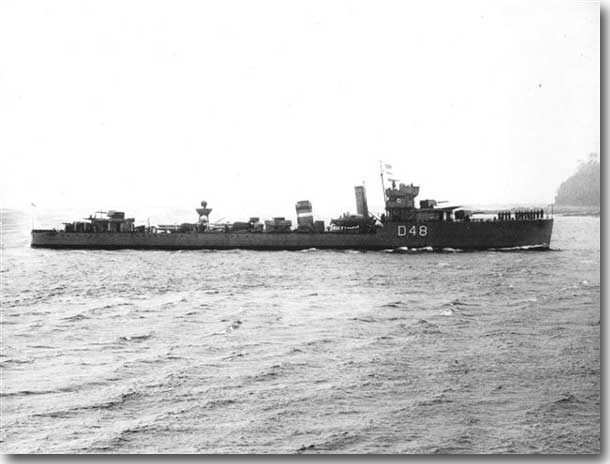
HMS Vidette (D48) was an Admiralty V-class destroyer of the Royal Navy, constructed during the latter stages of World War I. Built by Alexander Stephens & Sons Limited in Linthouse, Govan, she was laid down on February 1, 1917, launched on February 28, 1918, and completed by April 27, 1918. As a V-class destroyer, she featured the typical design of her class, with a length of approximately 312 feet, a beam of around 29 feet, and a displacement estimated at about 1,140 tons. Early in her service, she was part of the Grand Fleet, serving until the end of WWI, after which she was placed in reserve in 1923. Throughout the interwar period, Vidette remained mostly in reserve, although she was notably equipped with submarine detection gear (ASDIC) in 1923, making her one of the first British warships to feature this technology. By 1939, she was brought back to active duty, undergoing refits for convoy escort and anti-submarine warfare, including the installation of Type 286M radar during a 1941 refit at Gibraltar. During WWII, HMS Vidette was primarily based at Gibraltar, serving in the 13th Destroyer Flotilla. She participated in key operations such as the shelling of the French fleet at Mers-el-Kebir, Operation Lever (sinking of Dunkerque), and convoy escort missions to Malta, including Operation Collar and Operation Harpoon. In 1942, she was converted into a Long-Range Escort, with modifications that replaced her torpedo tubes with additional anti-submarine weapons and replaced boilers with fuel tanks to enhance her endurance. Assigned to the Western Approaches Command, Vidette became part of the B-7 Escort Group, where she played a significant role in convoy battles such as HX 231, ONS 5, and SC 130, credited with destroying five U-boats during her service. She also participated in supporting the Normandy landings (Operation Neptune) in June 1944. Her notable contributions earned her five battle honours, and she was credited with the destruction of five U-boats over her wartime career. Decommissioned in June 1945 and sold for scrap in April 1947, HMS Vidette remains a distinguished example of a wartime destroyer that adapted through technological upgrades and extensive service to become a vital asset in the Battle of the Atlantic.
This description has been generated using GPT-4.1-NANO based on the Vessel's wikidata information and then modified by ShipIndex.org staff.