
SM U-9
1910 Type U 9 submarine
Vessel Wikidata
* This information from Wikidata is available under the Creative Commons Attribution-ShareAlike License
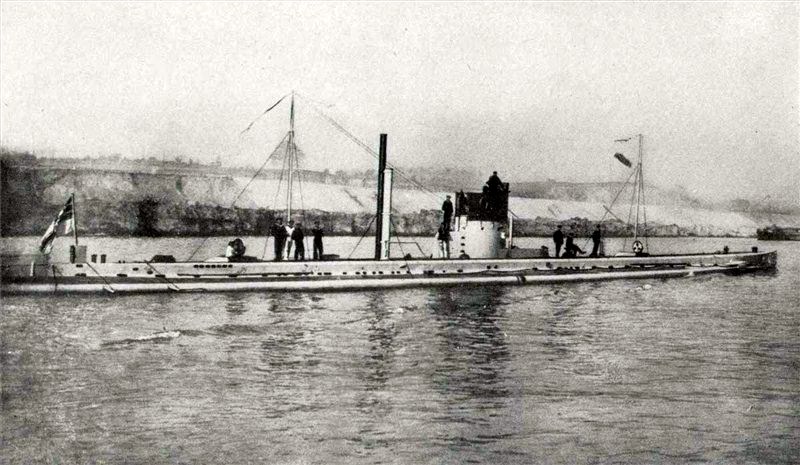
SM U-9 was a German Type U 9 U-boat constructed for the Imperial German Navy, notable for its significant role during World War I. Ordered on 15 July 1908, her keel was laid at Kaiserliche Werft in Danzig, and she was launched on 22 February 1910, entering service on 18 April 1910. The vessel measured 57.38 meters (188 feet 3 inches) in overall length, with a pressure hull length of 48 meters (157 feet 6 inches). Her beam was 6 meters (19 feet 8 inches), and she had a draught of 3.13 meters (10 feet 3 inches), with a total height of 7.05 meters (23 feet 2 inches). Displacing 493 tons when surfaced and 611 tons submerged, U-9 was powered by two Körting 8-cylinder and two Körting 6-cylinder two-stroke petrol engines generating 1,000 metric horsepower for surface travel. Underwater, she used Siemens-Schuckert electric motors producing a combined 1,160 PS (853 kW). These engines drove two shafts, each with a 1.45-meter (4.8-foot) propeller, allowing her to reach a top speed of 14.2 knots on the surface and 8.1 knots submerged. Her cruising range was 1,800 nautical miles at 14 knots on the surface and 80 nautical miles at 5 knots underwater, with a maximum diving depth of 50 meters. U-9 was armed with four 50 cm torpedo tubes—two at the bow and two at the stern—and carried six torpedoes. Initially equipped with a machine gun, she was later fitted with a 3.7 cm Hotchkiss gun and a 5 cm gun during 1914 and 1915, respectively. A major refit in 1916 added two mine-laying rails, although these were later removed. Her crew consisted of 4 officers and 31 enlisted men. U-9 achieved fame on 22 September 1914, when she sank three British cruisers—HMS Aboukir, HMS Hogue, and HMS Cressy—in the Broad Fourteens region of the North Sea by firing four torpedoes. This event marked one of the most notable submarine actions of the war, dramatically changing perceptions of submarine warfare’s potential. The sinking resulted in the deaths of 1,459 British sailors and demonstrated the effectiveness of submarine tactics. U-9 continued her patrols, sinking a total of 13 ships, including small fishing vessels and British steamers, until she was withdrawn from front-line service in April 1916 for training duties. Her distinguished service earned her, along with SMS Emden, the rare honor of the Iron Cross awarded by Kaiser Wilhelm II, underscoring her significance in maritime warfare history.
This description has been generated using GPT-4.1-NANO based on the Vessel's wikidata information and then modified by ShipIndex.org staff.