
HMS Bellerophon
1786 Arrogant-class third-rate ship of the line
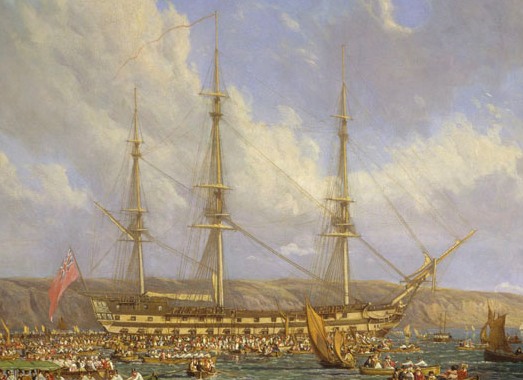
Vessel Wikidata
* This information from Wikidata is available under the Creative Commons Attribution-ShareAlike License
HMS Bellerophon, affectionately known as the "Billy Ruffian," was a formidable third-rate ship of the line of the Royal Navy, launched in 1786 from Frindsbury, Kent. She measured approximately 168 feet on the gundeck and 138 feet on the keel, with a beam of about 46 feet 10.5 inches, and displaced around 1,612 tons burthen. Armed with 74 guns, her armament comprised twenty-eight 32-pounder guns on her lower gundeck, twenty-eight 18-pounders on her upper gundeck, and fourteen 9-pounders on the quarterdeck and forecastle. Constructed to a modified Arrogant-class design, she featured a figurehead depicting the mythological Bellerophon riding Pegasus, symbolizing heroism and conquest. Her construction was delayed due to peace treaties, but she was finally launched in October 1786, after which her hull was copper-sheathed and fitted for service. Throughout her active career, HMS Bellerophon served primarily during the French Revolutionary and Napoleonic Wars, engaging in three major fleet battles: the Glorious First of June (1794), the Battle of the Nile (1798), and the Battle of Trafalgar (1805). She gained renown for her speed and resilience, earning the nickname "The Flying Bellerophon." Notably, she narrowly avoided capture at the First Battle of Groix in 1795, and she played a vital role in Nelson's fleet at the Nile, suffering severe damage while engaging the French flagship Orient. At Trafalgar, she fought fiercely, sustaining heavy casualties, including the death of her captain, John Cooke, and was involved in close-quarters combat with multiple enemy ships, including colliding with the French Aigle. Her service extended to blockades, convoy escort duties, and anti-privateering patrols in the Baltic and North Atlantic. In 1815, she earned her historic place in history when Napoleon Bonaparte surrendered aboard her after the Battle of Waterloo, marking the ship’s crowning moment. Following her illustrious career, she was converted into a prison ship in 1815, renamed Captivity in 1824 to free her original name, and continued in service until 1834. Sold for scrap in 1836, HMS Bellerophon is celebrated both for her combat record and her unique role in ending the Napoleonic Wars, leaving a lasting legacy in maritime history.
This description has been generated using GPT-4.1-NANO based on the Vessel's wikidata information and then modified by ShipIndex.org staff.