
HMS Express
1934 E-class destroyer
Vessel Wikidata
* This information from Wikidata is available under the Creative Commons Attribution-ShareAlike License
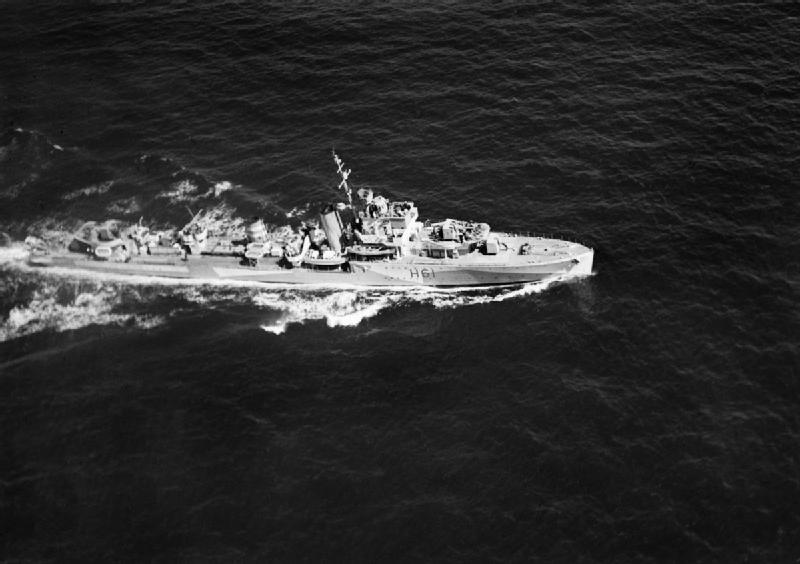
HMS Express was an E-class destroyer built for the Royal Navy in the early 1930s, with a displacement of approximately 1,405 long tons at standard load and 1,940 long tons at deep load. The vessel measured 329 feet in length overall, with a beam of 33 feet 3 inches and a draught of 12 feet 6 inches. Powered by two Parsons geared steam turbines driving two propellers, and fueled by three Admiralty three-drum boilers, she could reach a maximum speed of 35.5 knots. Her range was about 6,350 nautical miles at 15 knots, facilitated by a fuel capacity of 470 long tons. The ship's complement consisted of 145 officers and ratings. Armament included four 4.7-inch (120 mm) Mark IX guns in single mounts, two quadruple mounts for Vickers 0.5-inch AA machine guns, and two above-water quadruple torpedo tube mounts for 21-inch torpedoes. She was also equipped with a depth charge rail, two throwers, and initially carried 20 depth charges, which increased to 35 during the war. To accommodate her role as a minelayer, some armament and equipment, such as two of her 4.7-inch guns, torpedo tubes, minesweeping paravanes, and large boats, were removed. She was later modified into an escort destroyer, receiving radar, anti-aircraft guns, and anti-submarine equipment including a Hedgehog mortar and additional depth charges. Constructed by Swan Hunter & Wigham Richardson, she was ordered in November 1932, launched on 29 May 1934, and commissioned in November 1934. Her early service included attachment to the Home Fleet, a deployment to the Mediterranean during the Abyssinia Crisis, and patrols enforcing the Spanish Civil War non-intervention policies. During World War II, HMS Express participated in mine-laying operations, notably off the Heligoland Bight, and was involved in the Dunkirk evacuation, where she ferried over 3,400 troops. She suffered significant damage in August 1940 after striking a German mine, losing her bow. After repairs, she was part of Force Z, escorting the battleship Prince of Wales and battlecruiser Repulse to Singapore. She was present during the Japanese attack that sank both capital ships and rescued over 2,000 survivors. In 1943, she was converted into an escort destroyer and transferred to the Royal Canadian Navy, renamed Gatineau. She served in Atlantic convoy escort duties, participated in sinking a German U-boat, and prepared for the Normandy invasion. After the war, Gatineau was decommissioned, struck from the Navy List, and her hull was repurposed as a breakwater in British Columbia, remaining visible until around 2004. Her service record highlights her adaptability and active engagement in key naval operations during her career.
This description has been generated using GPT-4.1-NANO based on the Vessel's wikidata information and then modified by ShipIndex.org staff.