
HMS Implacable
1800 Téméraire-class third-rate ship of the line
Vessel Wikidata
* This information from Wikidata is available under the Creative Commons Attribution-ShareAlike License
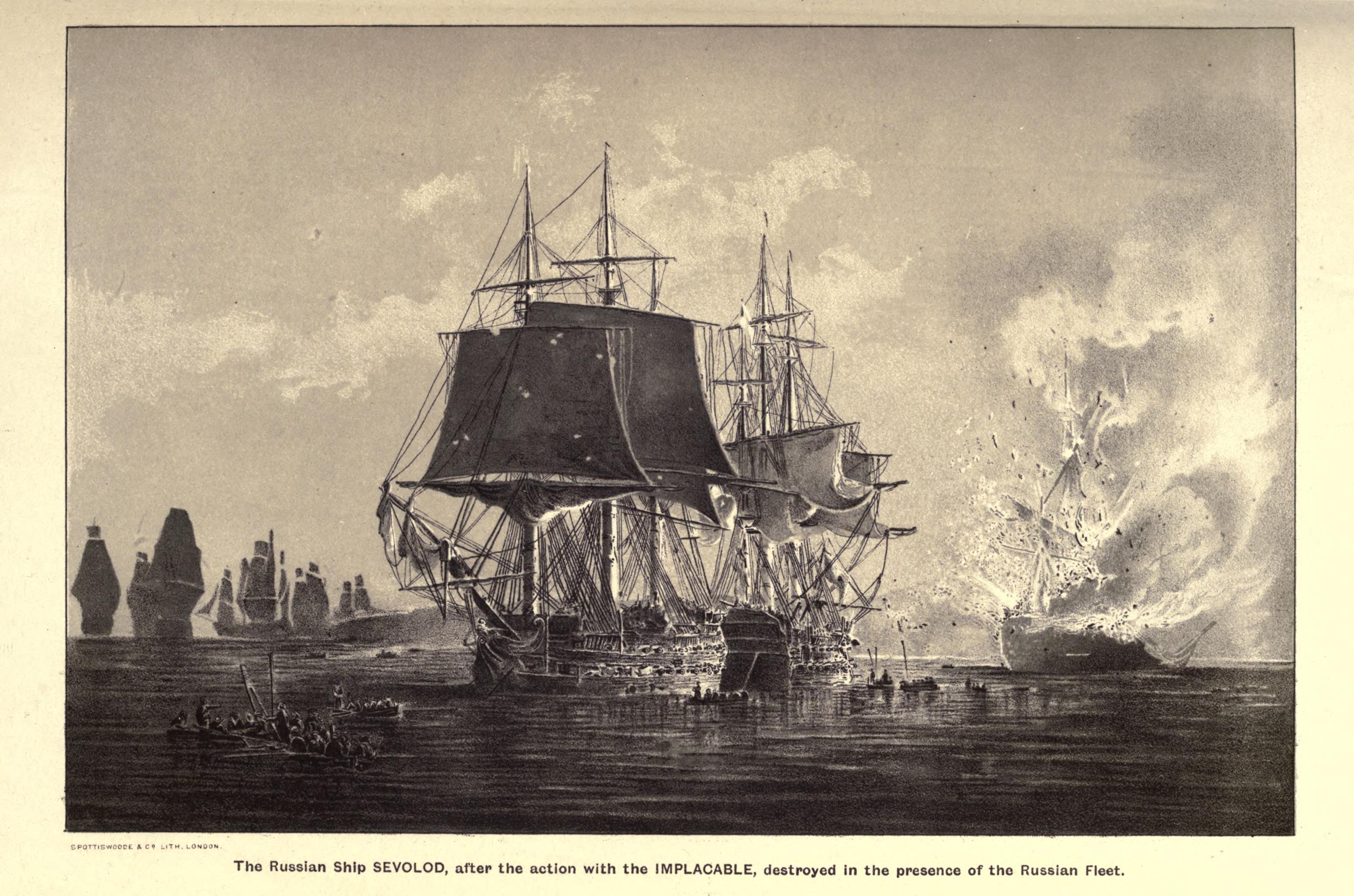
HMS Implacable was a third-rate, 74-gun ship of the line of the Royal Navy, originally built as the French Téméraire-class ship Duguay-Trouin. Launched in 1800 at Rochefort, she was constructed based on plans by Sané, with initial design work by Rolland. The ship's dimensions and armament positioned her as a formidable vessel within the line of battle, capable of engaging multiple enemy ships simultaneously. During her French service, Duguay-Trouin participated in notable actions such as the Blockade of Saint-Domingue and the Battle of Trafalgar in 1805, where she was part of the vanguard of the French fleet. She survived Trafalgar but was captured shortly thereafter at the Battle of Cape Ortegal when her masts were shot away, and her captain, Claude Touffet, was killed. In British service, she was renamed HMS Implacable and served during the Napoleonic Wars. She played a significant role in the Baltic, notably in 1808, where she engaged and captured the Russian 74-gun ship Vsevolod in a fierce action near Hanko Udd. During this engagement, she exchanged fire with Vsevolod, contributing to her eventual surrender and destruction. Implacable also participated in various other operations, including cutting out Russian vessels, supporting land operations in Spain, and later, in the 1840s, the bombardment and capture of Acre during the Syrian campaign. Later in her career, she served as a training ship from 1855, becoming one of the oldest ships in the Royal Navy. She was preserved as a historic vessel, serving as a boys' training ship and undergoing multiple restorations. In 1949, she was scuttled east of the Isle of Wight after decades of service and preservation efforts. Her figurehead and stern galleries are preserved in museums, symbolizing her maritime significance. Implacable’s long service life and participation in key naval battles underscore her importance in naval history, bridging the age of sail into the modern era.
This description has been generated using GPT-4.1-NANO based on the Vessel's wikidata information and then modified by ShipIndex.org staff.