
SMS Seeadler
ship

Vessel Wikidata
* This information from Wikidata is available under the Creative Commons Attribution-ShareAlike License
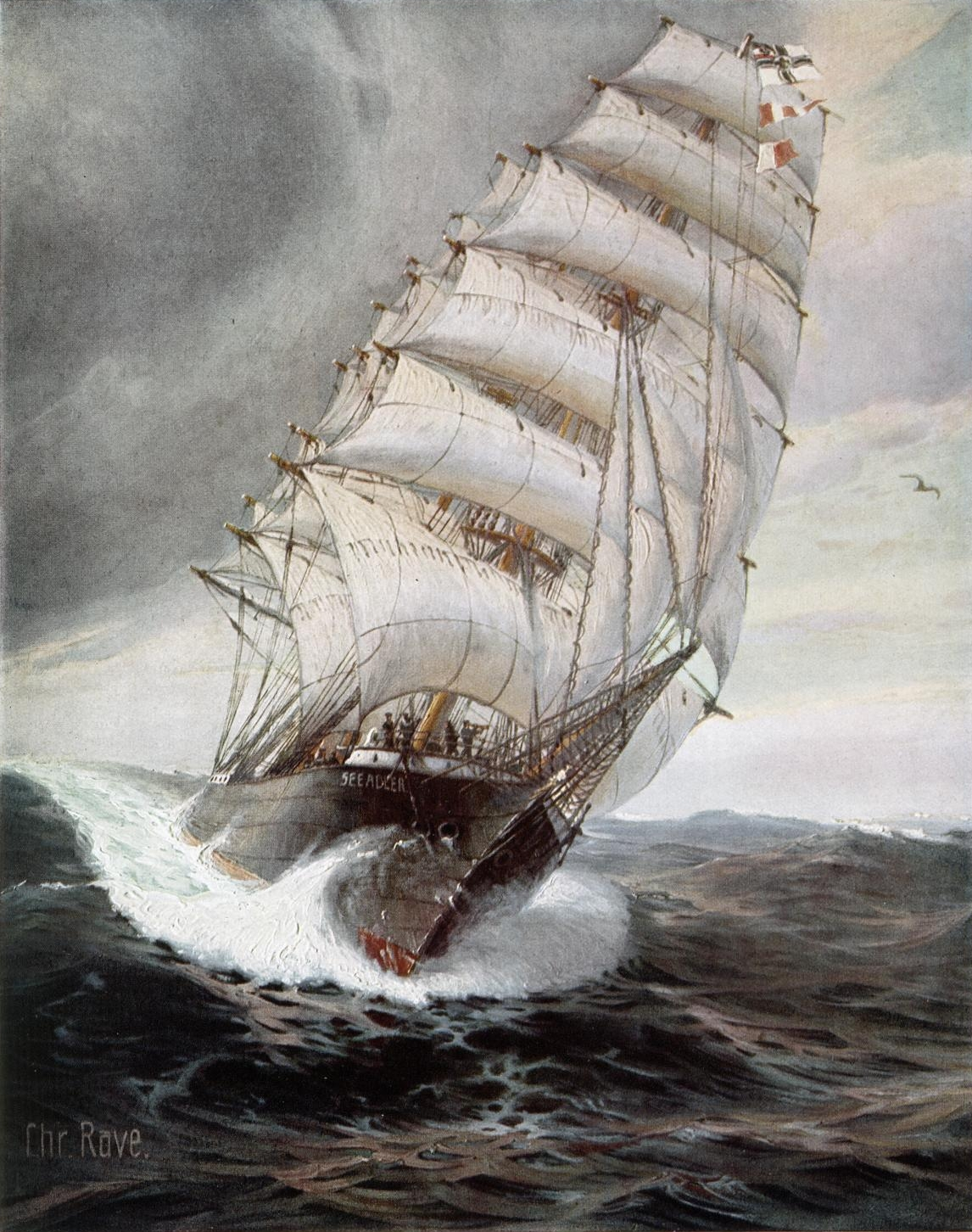
SMS Seeadler was a notable three-masted steel-hulled sailing ship that served as a German merchant raider during World War I. Originally launched as Pass of Balmaha on August 9, 1888, by Robert Duncan & Company in Port Glasgow, Scotland, she measured 245 feet (75 meters) in length with a beam of 39 feet (12 meters) and a depth of 23 feet (7 meters). The vessel was classified as a steel-hulled, ship-rigged sailing vessel, with a gross register tonnage (GRT) of 1,571. She was initially owned by Glasgow-based firms before being sold in 1908 to Montreal interests and later managed by American companies, with her registry shifting accordingly. During her commercial career, Pass of Balmaha operated under various flags and ownerships, including the United States flag during World War I. Her capture by the German U-boat SM U-36 in 1915 was a pivotal event. The ship was intercepted off Norway while en route from New York to Arkhangelsk with cotton for Russia. In a series of deceptive maneuvers, her crew hid the British prize crew and exchanged flags, but U-36 ultimately directed her to Cuxhaven for inspection, where she was seized by the Germans. Recommissioned as SMS Seeadler in 1916, she was converted into a commerce raider equipped with hidden armaments, including two 105 mm guns and machine guns, as well as accommodation for additional crew and prisoners. Under Kapitänleutnant Felix von Luckner, she disguised herself as a Norwegian wood carrier and successfully crossed the British naval blockade, capturing 15 ships totaling over 30,000 tons across her 225-day raiding career. Her success was marked by minimal casualties and innovative stealth tactics. Her operational history ended when she was wrecked on a reef at Mopelia in French Polynesia on August 2, 1917, following a tsunami that lifted and crushed her on the reef. She was burned in an effort to conceal her presence. Despite her destruction, she remained significant as one of the last fighting sailing ships used in wartime, demonstrating the strategic use of sailing vessels for commerce raiding in the restricted naval environment of WWI. Her career highlighted the enduring utility of sailing ships in modern naval warfare and her daring exploits remain a notable chapter in maritime military history.
This description has been generated using GPT-4.1-NANO based on the Vessel's wikidata information and then modified by ShipIndex.org staff.