
Tsukuba
1854 sail-steamer corvette
Vessel Wikidata
* This information from Wikidata is available under the Creative Commons Attribution-ShareAlike License
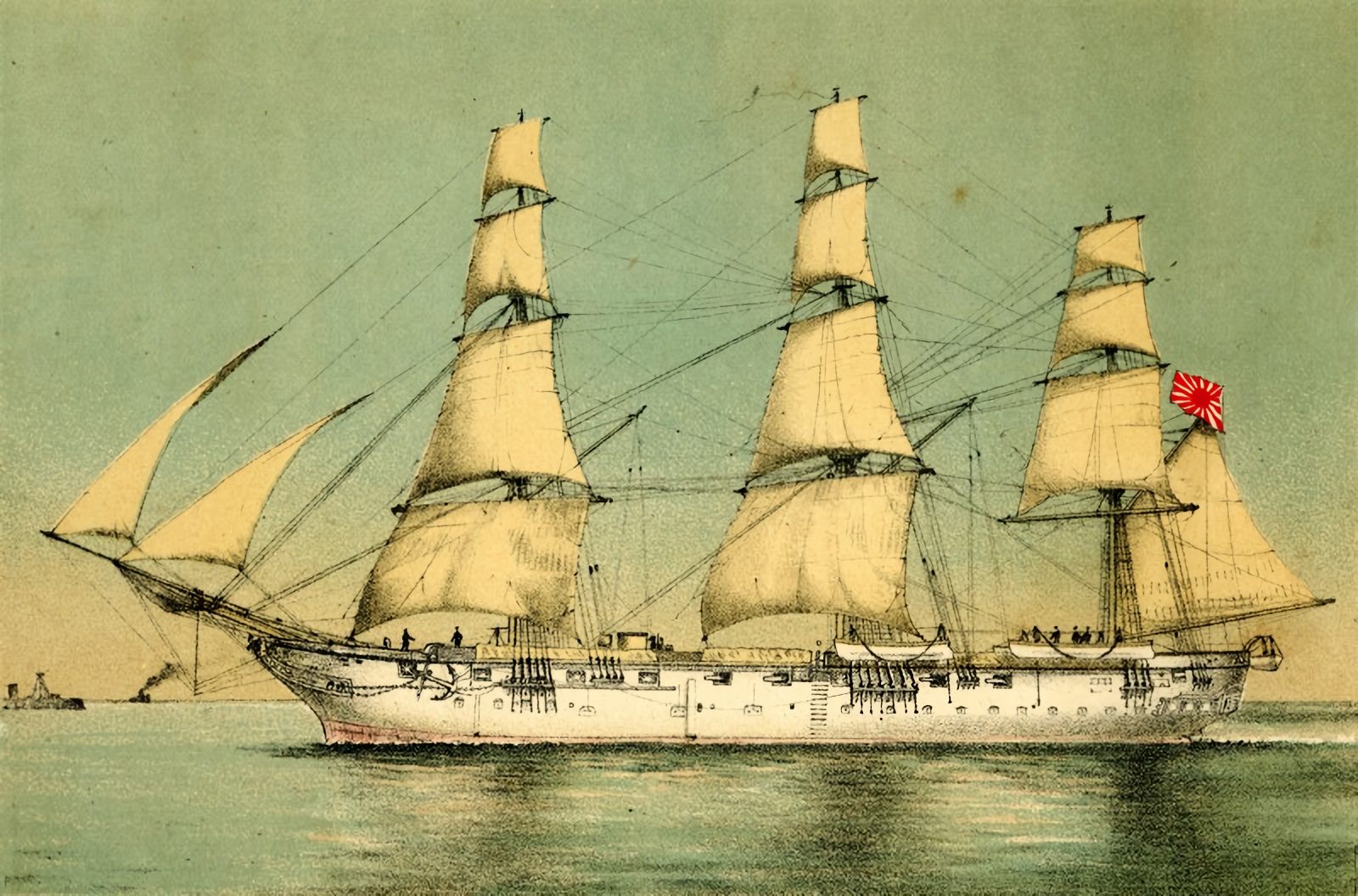
HMS Malacca was a 17-gun wooden sloop constructed of teak, ordered from Moulmein, Burma, in 1847, with her keel laid in January 1849. She was launched on June 2, 1851, with a length of approximately 192 feet on her gundeck and a keel length of about 168 feet, making her a sizable vessel for her class. Her beam measured around 34 feet, and her depth of hold was approximately 22 feet 8 inches. Her builder’s measure tonnage was recorded at 1,034 tons, and her draft forward was 15 feet 10 inches, increasing to 18 feet 10 inches aft. Initially, HMS Malacca was rigged with three masts and a full sail plan, complemented by her steam machinery, which was installed between 1854 and 1855. Her original propulsion was powered by a two-cylinder inclined single expansion trunk (ISET) steam engine supplied by John Penn & Sons, with two fire-tube rectangular boilers. This engine produced about 200 nominal horsepower, driving a single screw propeller. In 1862, she was re-engined with a Humphry's & Tennant two-cylinder horizontal single expansion engine, featuring larger cylinders of 42.25 inches in diameter and a 26-inch stroke, enhancing her propulsion capabilities. Her armament consisted of one 8-inch 65 cwt muzzle-loading shell gun mounted on a pivot and sixteen 32-pounder 32 cwt muzzle-loading smoothbore guns on broadside trucks, making her a formidable vessel for her time. The ship’s figurehead was a turbaned male bust, designed by Hellyer & Sons, and held in the Royal Navy’s collection, reflecting her naval heritage and the era’s maritime traditions. HMS Malacca served actively during the Crimean War, joining Sir Robert Napier’s Baltic Fleet and later operating in the Black Sea. She also served on the North America and West Indies Station and in the Mediterranean, participating in rescue operations such as saving survivors from the boiler explosion of the Royal Sicilian Navy ship Carlo III. Throughout her service, she was reclassified as a corvette in 1862 and experienced several incidents, including running aground at Malta and in the Lorenzo Channel. Decommissioned in 1869, she was sold to E. Bates and subsequently transferred to the Imperial Japanese Navy, where she was renamed Tsukuba. She served as a training ship until approximately 1900 and was broken up in 1906. HMS Malacca's extensive service history and adaptations highlight her importance in mid-19th-century naval operations and maritime technology development.
This description has been generated using GPT-4.1-NANO based on the Vessel's wikidata information and then modified by ShipIndex.org staff.