
HMS Chatham
1911 Chatham-class light cruiser
Vessel Wikidata
* This information from Wikidata is available under the Creative Commons Attribution-ShareAlike License
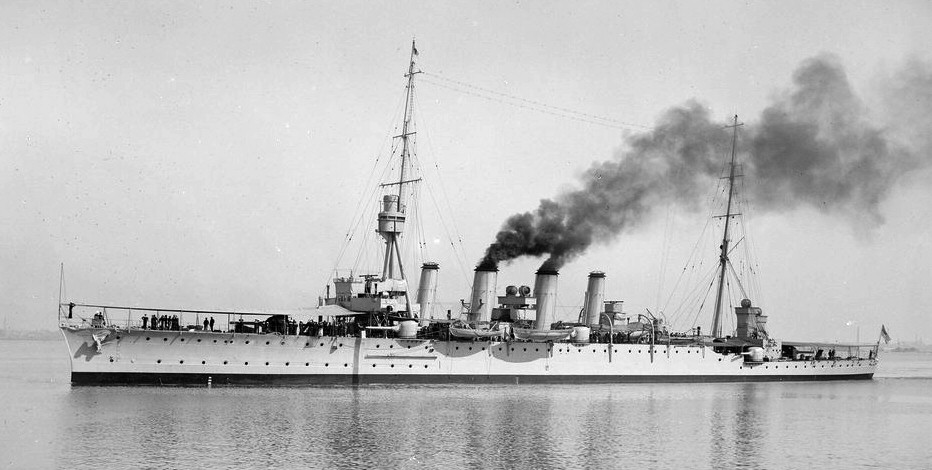
HMS Chatham was a Town-class light cruiser constructed for the Royal Navy during the 1910s, serving as the lead ship of her sub-class, which was an improved and slightly larger version of the Weymouth sub-class. She measured 457 feet (139.3 meters) in overall length, with a beam of 49 feet (14.9 meters) and a draught of 16 feet (4.9 meters). Her displacement was 5,400 long tons at normal load, increasing to 6,000 long tons when fully loaded. Propulsion was provided by twelve Yarrow boilers feeding Parsons steam turbines, driving four propeller shafts rated at 25,000 shaft horsepower, which enabled a top speed of approximately 26.1 knots (48.3 km/h). The ship's fuel capacity included 1,200 long tons of coal and 260 long tons of oil, granting her an operational range of 4,460 nautical miles at 10 knots. Her armament comprised eight BL 6-inch (152 mm) Mk XI guns, with two mounted on the centerline fore and aft of the superstructure, and four amidships on the forecastle deck to ensure all-weather operation. These guns were protected by shields. Additionally, she was equipped with four Vickers 3-pounder saluting guns and two submerged 21-inch torpedo tubes. Laid down on 3 January 1911 at Chatham Royal Dockyard and launched on 6 November, HMS Chatham was completed in December 1912. Initially assigned to the 2nd Battle Squadron, she was transferred to the 2nd Light Cruiser Squadron in the Mediterranean in July 1913. During World War I, she participated in notable operations including searching for the German battlecruiser Goeben and cruiser Breslau, and was engaged in the pursuit of the German light cruiser Königsberg in East Africa. Her service included supporting landings at Gallipoli in 1915, acting as a flagship during the landings at Suvla Bay, and later serving with the Grand Fleet. In 1916, Chatham struck a mine off Norfolk, requiring repairs. Post-war, she was lent to the Royal Navy's New Zealand Division from 1920 to 1924, during which she became the first Bermuda-based Royal Navy vessel to transit the Panama Canal. She was eventually sold for scrap in 1926. Her legacy includes the donation of the Chatham Cup, New Zealand’s premier football trophy, by her crew in 1922.
This description has been generated using GPT-4.1-NANO based on the Vessel's wikidata information and then modified by ShipIndex.org staff.