
SS Great Eastern
British sailing steamship
Vessel Wikidata
* This information from Wikidata is available under the Creative Commons Attribution-ShareAlike License
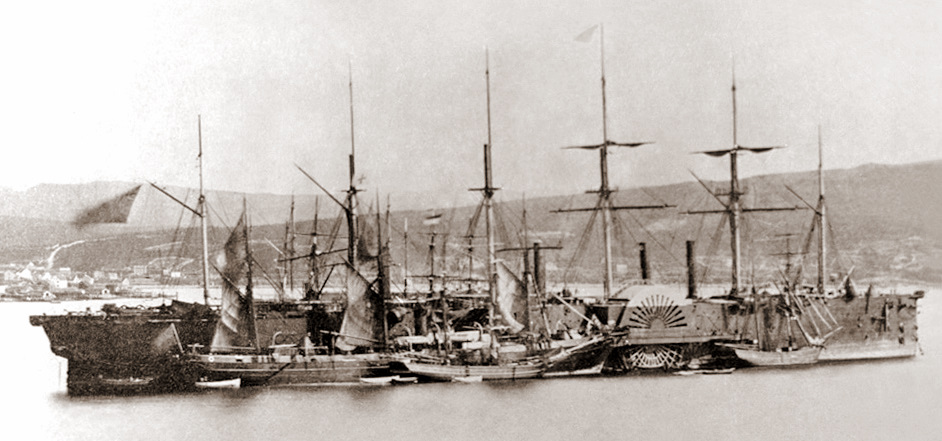
The SS Great Eastern was an monumental iron-hulled steamship designed by the renowned engineer Isambard Kingdom Brunel and constructed by John Scott Russell & Co. at Millwall Iron Works on the River Thames. Launched in 1858, she was the largest ship of her time, measuring approximately 692 feet (211 meters) in length and displacing around 32,000 tons fully loaded. Her beam was 25 meters (82 feet), with a draught of 6.1 meters (20 feet) unloaded and 9.1 meters (29 feet 10 inches) when laden. The vessel featured a double-hulled construction with 19-millimeter wrought iron plates, ribs every 1.8 meters, and nineteen compartments internally divided by longitudinal and transverse bulkheads, making her a pioneering example of double-skinned hulls for safety. Her propulsion system was notably complex for her era, combining steam engines powering two sets of paddle wheels, each 17 meters (55 feet 9 inches) in diameter, with a four-bladed screw propeller 7.3 meters (23 feet 11 inches) across. She was rigged with six masts, equipped with extensive sail plans, although sails proved impractical when under steam because of the heat from her funnels. Her engines produced an estimated 6,000 kilowatts (8,000 horsepower), enabling her to reach speeds of up to 13 knots (24 km/h; 15 mph). Brunel envisioned her as a "floating city," capable of crossing the Atlantic without refueling, and potentially monopolizing trade routes to Australia and Asia. Her construction was marred by accidents, including a failed launch in 1857 that resulted in fatalities, and a steam explosion in 1859 during her fitting out that killed five crew members. Brunel died shortly after her maiden voyage, which was also damaged by an explosion. Despite her grandeur and engineering marvels, her commercial ventures were largely unprofitable, prompting her to be repurposed for laying the first transatlantic telegraph cable in 1866, a task she performed successfully, laying cables between Newfoundland and Europe. Throughout her career, she served various roles: a passenger liner, cable layer, military transport, and later as a floating exhibition, concert hall, and advertising hoarding. Her size and innovations marked her as a significant milestone in maritime engineering, although her operational costs and financial difficulties prevented her from becoming a sustainable commercial vessel. Ultimately, she was broken up in 1889–1890, but her legacy endures as an iconic symbol of Victorian engineering ambition and innovation.
This description has been generated using GPT-4.1-NANO based on the Vessel's wikidata information and then modified by ShipIndex.org staff.