
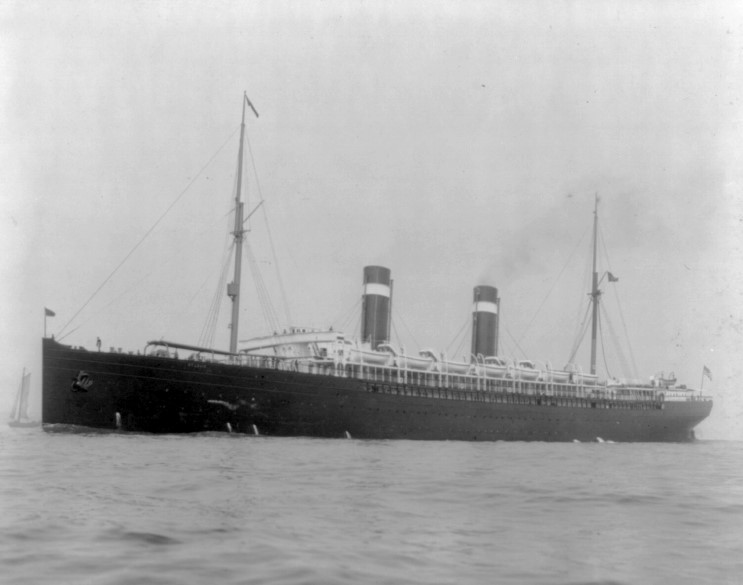
SS St. Louis
American transatlantic passenger liner
Vessel Wikidata
* This information from Wikidata is available under the Creative Commons Attribution-ShareAlike License
The SS St. Louis was a notable passenger liner built in 1894, primarily serving transatlantic routes between New York and Southampton, England. Owned by the International Navigation Company of New York City, she was registered in the United States and sponsored by Frances Cleveland, wife of President Grover Cleveland. The vessel was constructed to operate in the increasingly competitive transatlantic passenger market, and her construction was significant enough to incorporate the Southampton Docks Company’s new Prince of Wales Graving Dock, the largest dry dock in the world at the time, facilitating easier maintenance and dry docking in Southampton. Physically, the SS St. Louis was a significant vessel of her era, designed for passenger service, though specific dimensions are not detailed in the source. Her service history includes notable military roles during both the Spanish–American War and World War I. During the Spanish–American War, she was requisitioned by the U.S. Navy, renamed USS St. Louis, and armed with four 5-inch guns and eight 6-pounders. She played a crucial role in the naval campaign, undertaking cable-cutting operations to isolate Spanish forces in Cuba, engaging in gunfire at Santiago de Cuba, and capturing prisoners including Admiral Cervera. Her actions contributed to the blockade and eventual destruction of the Spanish fleet in 1898. Following her military service, the SS St. Louis resumed her role as a prominent passenger liner, reinforcing her importance in transatlantic travel. She was equipped with defenses during World War I, including armed guards and guns, successfully evading German U-boat attacks in 1917. In April 1918, she was transferred to the U.S. Navy, renamed Louisville, and served as a troop transport, bringing American soldiers back from Europe until her decommissioning in 1919. Her maritime significance lies in her dual military and commercial roles, exemplifying the versatility of late 19th and early 20th-century liners. Her service record reflects the broader history of maritime warfare, transatlantic passenger travel, and the evolution of naval auxiliary vessels. Her eventual destruction by fire in 1920 and subsequent scrapping in Italy marked the end of a vessel that had seen notable service in both peace and war.
This description has been generated using GPT-4.1-NANO based on the Vessel's wikidata information and then modified by ShipIndex.org staff.