
SS Tynwald
passenger vessel

Vessel Wikidata
* This information from Wikidata is available under the Creative Commons Attribution-ShareAlike License
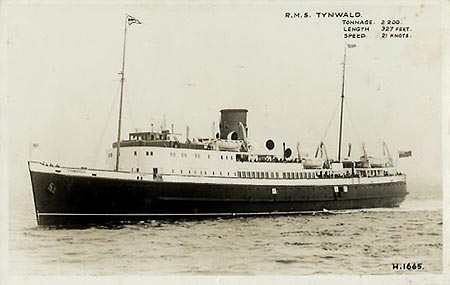
The SS Tynwald (RMS No. 165281) was a notable passenger vessel operated by the Isle of Man Steam Packet Company from 1937 until her loss in 1942. Built by Vickers Armstrong in Barrow-in-Furness, she was launched on December 16, 1936, alongside her nearly identical sister ship, Fenella. Tynwald measured a gross registered tonnage of 2,376 tons, with a length of 314 feet 6 inches, a beam of 46 feet, and a draught of 18 feet. Her design speed was 21 knots, making her a swift vessel suitable for passenger and mail service between Liverpool and Douglas, primarily during winter operations. Tynwald’s external appearance was distinguished by subtle differences from her twin Fenella, including her upper strake painted white and her bow markings featuring the ship's name and the Three Legs of Man symbol. Internally, the ships differed in decor; Tynwald’s first-class dining saloon was paneled with Queensland walnut, and her first-class lounge featured figured chestnut with a green and gold scheme, contrasting with Fenella’s Australian walnut decor. Her passenger capacity was 1,968, with crew accommodations for 68. In service, Tynwald was involved in notable events, including transporting the newly appointed Lieutenant Governor of the Isle of Man in October 1937. During a storm in November 1937, she sustained damage attempting to berth at Douglas. With the outbreak of World War II, she was requisitioned as a personnel vessel and participated in the Dunkirk evacuation, where she embarked more troops than any other vessel, ultimately rescuing over 8,900 troops. Converted into an auxiliary anti-aircraft ship in late 1940, she was commissioned as HMS Tynwald in October 1941. Armed with 6 4-inch AA guns and eight 2-pounder AA guns, she served in convoy escort duties around Britain and participated in Operation Torch, the Allied invasion of North Africa. During the assault near Bougie in November 1942, she was torpedoed by the Italian submarine Argo and sank in approximately 13 meters of water. Her loss marked a significant maritime event during her wartime service, with survivors rescued by accompanying vessels.
This description has been generated using GPT-4.1-NANO based on the Vessel's wikidata information and then modified by ShipIndex.org staff.