
SS Winfield Scott
Ship used in 1850s
Vessel Wikidata
* This information from Wikidata is available under the Creative Commons Attribution-ShareAlike License
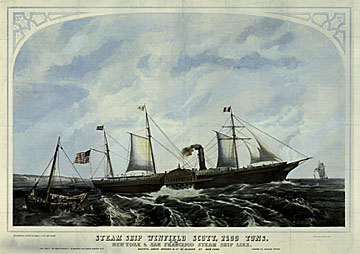
The SS Winfield Scott was a sidewheel steamer built in 1850 by the New York-based shipbuilding company Westervelt and MacKay. Constructed with a wooden hull reinforced with double iron bracing, the ship utilized materials such as White oak, Live oak, Locust, Redcedar, and Georgia yellow pine, emphasizing strength, safety, and speed. Launched on October 27, 1850, and originally intended to be named Placer, the vessel was named after the renowned U.S. Army general Winfield Scott, with a bust of him affixed to the stern. Initially operating on the New York-New Orleans route under ownership of Davis, Brooks and Company, the SS Winfield Scott was transferred in 1852 to the New York and San Francisco Steamship Company, arriving in San Francisco in April 1852. There, she shifted focus to transporting gold seekers along the Panama Route, connecting San Francisco with Panama, during the California Gold Rush era. In July 1853, ownership transferred again to the Pacific Mail Steamship Company, aligning her with the burgeoning demand for swift transit across the isthmus. On December 1, 1853, while en route from San Francisco to Panama, the Winfield Scott encountered heavy fog in the Santa Barbara Channel. Despite efforts to save time by navigating through the channel, she ran aground on Middle Anacapa Island at approximately 11 PM, while traveling at an estimated speed of 10 knots. The grounding was catastrophic; the ship struck the island bow first, and attempts to back away resulted in the loss of her rudder. The ship flooded rapidly, forcing the evacuation of up to 500 passengers and crew within two hours. Survivors camped on the island's rocky pinnacles overnight before being rescued by the steamship SS California, which recovered many of the survivors and the ship’s gold bullion. The wreck of the Winfield Scott now lies submerged under 25–30 feet of water within the Channel Islands National Park and Marine Sanctuary. Discovered in 1981 and listed on the National Register of Historic Places in 1988, the site remains protected by law. Salvage operations in 1894 and during World War II recovered machinery, copper bolts, iron, and brass, but much of the wooden hull has disintegrated over time. Today, the wreck is a significant archaeological site, representing mid-19th-century shipbuilding, with remnants of machinery still visible. The area remains notorious for its challenging navigation conditions, and efforts to preserve the site reflect its historical importance.
This description has been generated using GPT-4.1-NANO based on the Vessel's wikidata information and then modified by ShipIndex.org staff.