
HMS Belfast
1938 Edinburgh-class light cruiser
_(9899954683).jpg)
Vessel Wikidata
* This information from Wikidata is available under the Creative Commons Attribution-ShareAlike License
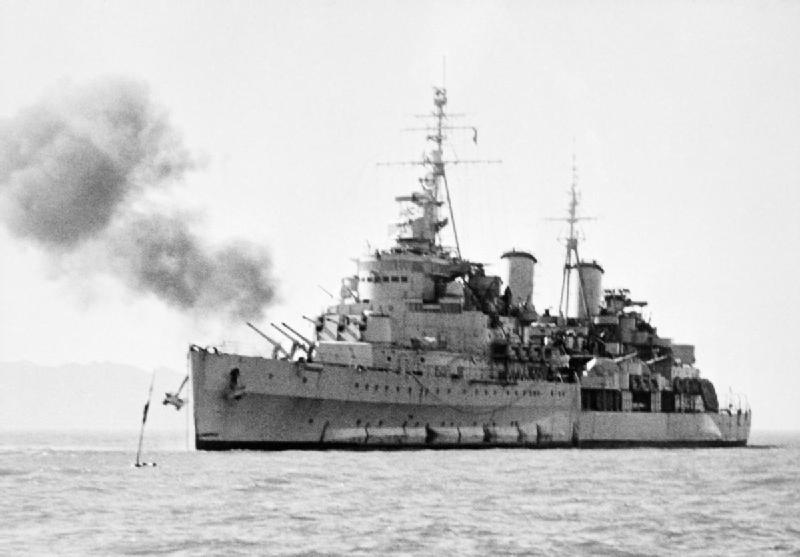
HMS Belfast is a Town-class light cruiser constructed for the Royal Navy, notable for its extensive service during World War II and subsequent conflicts, and now preserved as a museum ship on the River Thames in London. Launched on Saint Patrick’s Day in 1938 and commissioned in August 1939, Belfast measures approximately 613 feet 6 inches in length, with a beam of 63 feet 4 inches, and a draught of around 17 feet 3 inches. Her standard displacement during sea trials was about 10,420 long tons, and she was powered by four oil-fired Admiralty water-tube boilers driving Parsons geared steam turbines, which enabled her to reach speeds of up to 32.5 knots and a maximum range of roughly 8,664 nautical miles at 13 knots. Belfast's main armament comprised twelve 6-inch guns in four triple turrets, capable of firing up to 96 rounds per minute, and supported by secondary 4-inch guns, anti-aircraft weapons including Bofors and pom-poms, torpedo tubes, and depth charges. Her armor included a 4.5-inch belt and up to 4 inches of turret armor, providing substantial protection for her size. She carried two catapult-launched Supermarine Walrus amphibious aircraft, operated from hangars amidships, for reconnaissance and patrol. Her wartime service was distinguished. She initially participated in the naval blockade against Germany, narrowly avoiding destruction after striking a German mine in November 1939, which caused extensive damage. After repairs, Belfast returned to duty, escorting Arctic convoys, supporting the Normandy landings, and engaging in key battles such as the Battle of North Cape in December 1943, where she played a vital role in the sinking of the German battleship Scharnhorst. She also participated in operations against the German battleship Tirpitz and served in the Far East during the final stages of WWII. Post-war, Belfast saw service during the Korean War and underwent extensive modernization between 1956 and 1959, including updates to her armament, radar systems, and internal accommodations. Her active service ended in the 1960s, after which she was preserved as a museum ship. Now permanently moored on the Thames, she is operated by the Imperial War Museum and serves as a prominent historical exhibit and educational resource, with open decks, restored compartments, and interactive exhibits illustrating her wartime history and life at sea.
This description has been generated using GPT-4.1-NANO based on the Vessel's wikidata information and then modified by ShipIndex.org staff.