
HMS Ashanti
1937 Tribal-class destroyer
Vessel Wikidata
* This information from Wikidata is available under the Creative Commons Attribution-ShareAlike License
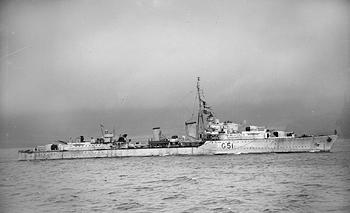
HMS Ashanti was a Tribal-class destroyer of the Royal Navy, launched from William Denny’s Dumbarton shipyard on 5 November 1937 and commissioned on 21 December 1938. Displacing approximately 1,891 long tons at standard load and up to 2,519 long tons at deep load, she measured 377 feet in length, with a beam of 36 feet 6 inches and a draught of 11 feet 3 inches. Her propulsion system comprised two Parsons geared steam turbines powered by three Admiralty three-drum boilers, delivering a total of 44,000 shaft horsepower, which enabled her to reach a maximum speed of around 36 knots. During sea trials, she achieved speeds of 37.4 knots. The ship carried a fuel range of about 5,700 nautical miles at 15 knots, and her crew numbered approximately 190 officers and ratings, with additional personnel aboard flotilla leaders. Her armament included eight 4.7-inch (120 mm) QF Mark XII guns in four superfiring twin mounts, complemented by anti-aircraft weaponry: a quadruple 40 mm "pom-pom," two quadruple 0.5-inch machine guns, and a single quadruple 21-inch torpedo mount. Although not primarily anti-submarine in design, she was equipped with ASDIC, a depth charge rack, and two throwers, with wartime depth charge loads increasing from 20 to 30 and later to 46. HMS Ashanti’s service was notable for her participation in key WWII campaigns. She visited Takoradi in the Gold Coast shortly after commissioning, presenting a silver bell and gold shield to the Ashanti chief, a rare instance of her fulfilling the intended tradition of visits to her namesake land. During the war, she escorted convoys, participated in the Norwegian Campaign, and was involved in the rescue efforts following the sinking of HMS Transylvania. She also took part in Operation Archery in Norway, Arctic convoy escort missions—including PQ 18—and supported the invasion of North Africa during Operation Torch. Her actions extended to the English Channel, where she engaged German surface ships during the Battle of Ushant in June 1944, and she sank multiple German vessels during operations against coastal and convoy targets. Throughout her wartime service, HMS Ashanti endured significant damage—from running aground during a minefield clearance operation to the rigors of battle—yet she remained active until the end of WWII. After the war, she was placed in reserve, used for target trials, and ultimately broken up in 1948. Her service exemplifies the power, versatility, and resilience of the Tribal-class destroyers in WWII maritime history.
This description has been generated using GPT-4.1-NANO based on the Vessel's wikidata information and then modified by ShipIndex.org staff.