
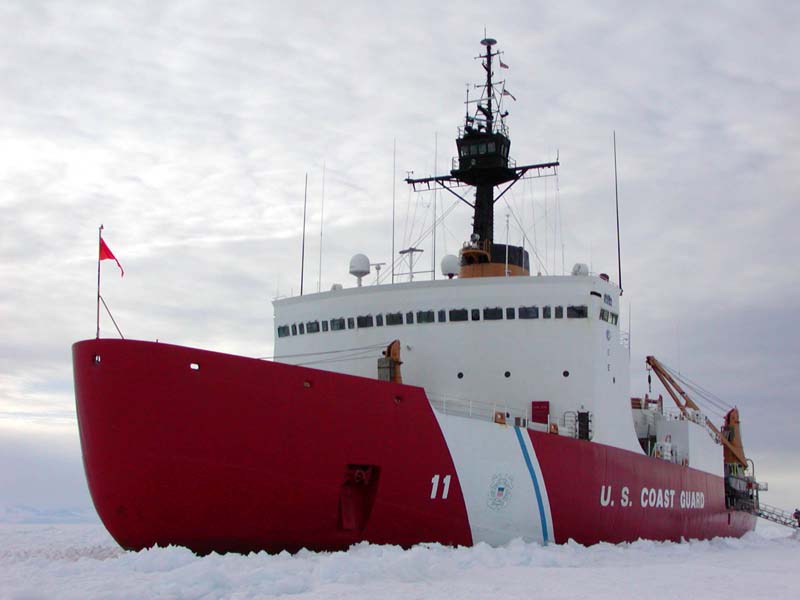
USCGC Polar Sea
heavy icebreaker ship
Vessel Wikidata
* This information from Wikidata is available under the Creative Commons Attribution-ShareAlike License
The USCGC Polar Sea (WAGB-11) is a United States Coast Guard heavy icebreaker commissioned on February 23, 1978. Constructed by Lockheed Shipbuilding and Construction Company in Seattle, she shares her design with her sister ship, Polar Star. The vessel has a robust steel hull engineered for extreme cold and icebreaking operations, with hull plating up to 1¼ inches thick in critical areas such as the bow and stern, and internal support featuring canted ribs to enhance strength. Her hull shape is optimized for icebreaking, combining a curved bow and heavy weight (approximately 13,000 tons) to enable effective cusp breaking and high-powered ice navigation. Under optimal conditions, Polar Sea can break through 6 feet of new, hard ice at a speed of 3 knots and can handle ice up to 21 feet thick using back-and-ram techniques; notably, she once traversed 40 feet of sea ice during a transit to Point Barrow, Alaska. Powering her operations are six diesel-electric generators and three gas turbines, each capable of producing a combined 18,000 shaft horsepower and up to 75,000 demand shaft horsepower respectively. Her propulsion system includes three shafts, each fitted with a 16-foot controllable-pitch propeller, allowing her to maintain high maneuverability in icy waters. The vessel's systems are managed by a computerized propulsion control system, ensuring efficient performance during demanding icebreaking missions. Polar Sea’s primary missions include resupplying Antarctic stations, notably McMurdo Station in the Ross Sea, and supporting scientific research with onboard laboratories, workspaces, and equipment for fields such as geology and oceanography. She has also operated with two HH-65 Dolphin helicopters for ice reconnaissance, cargo transfer, and rescue operations. Throughout her service, Polar Sea has achieved notable milestones, including being the first ship to reach Point Barrow in winter (1981) and one of only three ships to transit the Arctic Ocean and circumnavigate North America. She also reached the North Pole in 1994 alongside the CCGS Louis S. St-Laurent. Her operational history includes navigating the Northwest Passage without Canadian authorization in 1985, igniting diplomatic tensions. Her service effectively ended in 2010 due to engine failures, and she has since been used as a parts donor for her sister ship, Polar Star. As of 2024, Polar Sea has been placed in mothball status at Suisun Bay, California.
This description has been generated using GPT-4.1-NANO based on the Vessel's wikidata information and then modified by ShipIndex.org staff.