
USRC Harriet Lane
Union and (from 1863) Confederate steamship
Vessel Wikidata
* This information from Wikidata is available under the Creative Commons Attribution-ShareAlike License
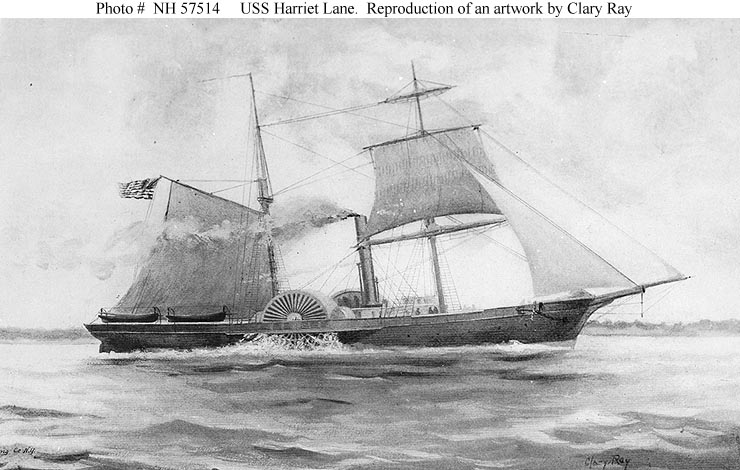
The USRC Harriet Lane was a copper-sheathed revenue cutter launched in November 1857, built by William H. Webb in New York City. She measured approximately 180 feet in length, 30 feet in beam, and had a draft of about 12 feet. Powered by a double-right-angled marine engine driving two side paddles, she could reach speeds of up to eleven knots. Her hull was copper-fastened and she was equipped with two masts supporting her rigging. Her construction included a series of magazines, engine machinery, and crew quarters arranged from stern to bow, with the captain's cabin and staterooms situated above the aft magazine and additional officer quarters amidships. She was armed initially with "light guns," including three thirty-two-pounders and four twenty-four-pound howitzers, later upgraded with heavier artillery such as a four-inch rifled Parrott gun, nine-inch Dahlgren guns, and other ordnance, reflecting her transition to military service during the Civil War. Her crew numbered around 95 men, supplied with small arms. Commissioned for the U.S. Revenue Service, Harriet Lane was launched in 1857 and assigned to various duties, including a diplomatic mission to Paraguay, where her presence helped secure reparations after an attack on Water Witch. She was transferred briefly to the U.S. Navy in late 1858 and again in 1861, serving prominently during the Civil War. Harriet Lane participated in key operations such as the Union's first engagement at Fort Sumter, the Battle of Pig Point, and the blockade and capture of Confederate strongholds like Galveston and Vicksburg. She was actively involved in the Battle of Hatteras Inlet Batteries, supporting landings and bombarding Confederate defenses, and later joined Admiral Farragut’s fleet in the Mississippi River campaign. Her service was marked by notable engagements, including firing the first naval shot of the Civil War, and she played a strategic role in Union blockades and river operations. Harriet Lane was captured by Confederate forces during the Battle of Galveston in January 1863, after being raked with gunfire and rammed, resulting in the death of her commanding officer, Lieutenant Wainwright. After her capture, she was converted to Confederate use, renamed Lavinia, and operated as a blockade runner until she was interned in Havana at the war's end. Post-war, she was deemed unfit for naval service and sold, becoming a civilian merchant vessel under the name Elliot Ritchie. She was eventually abandoned at sea following a fire in 1884. Harriet Lane’s varied career highlights her importance both as a revenue cutter and a Civil War combatant, reflecting the versatility and strategic value of such vessels during the period.
This description has been generated using GPT-4.1-NANO based on the Vessel's wikidata information and then modified by ShipIndex.org staff.