
USRC Naugatuck
revenue cutter of the United States
Vessel Wikidata
* This information from Wikidata is available under the Creative Commons Attribution-ShareAlike License
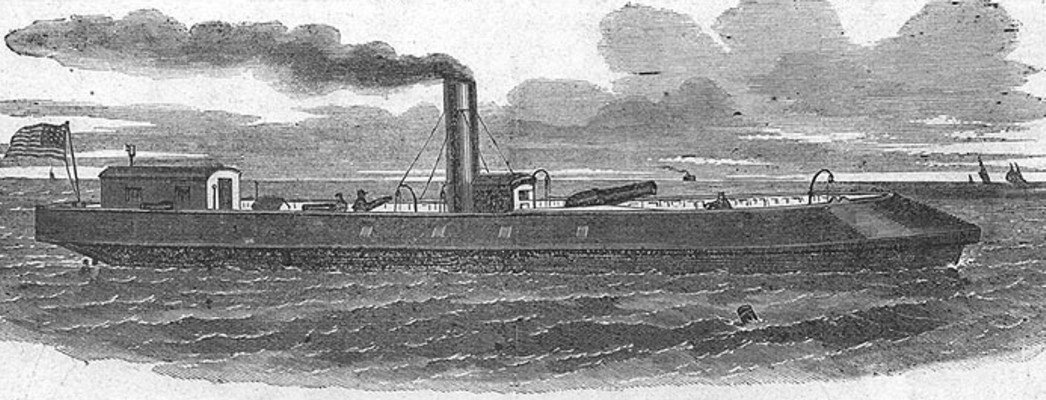
The USRC Naugatuck was an innovative twin-screw ironhull steamer built in 1844 by H.R. Dunham & Company in New York City, originally intended for commercial use by the Ansonia Copper and Brass Company. It measured approximately 18 inches above the deck, with a wooden bulwark of solid cedar measuring about 4.5 feet in depth, providing some protection from enemy fire. The vessel featured a low-lying armored band or skirt surrounding the main deck, with the hull constructed entirely of iron, emphasizing her experimental nature. During the American Civil War, the vessel was initially operated by the United States Revenue-Marine and was known as USRC E. A. Stevens before being renamed Naugatuck in 1863. The vessel was extensively modified by Robert L. Stevens, who replaced her original engine with a twin-propeller arrangement driven by inclined engines and a single boiler. She was equipped with interior ballast tanks fore and aft, which could be flooded or drained rapidly using heavy-duty centrifugal pumps—allowing her to alter her draft from 7 feet 8 inches to 9 feet 10 inches and to become semi-submersible. Her design enabled her to reduce her freeboard to minimize vulnerability to enemy fire, with her machinery kept below the waterline. Notably, Naugatuck featured a low, angled armor band protecting the main deck and a cedar bulwark, which, combined with her ballast tanks, made her semi-submersible and capable of rapid sinking or rising. Her armament included a 100-pound Parrott rifle, although this was prone to catastrophic failure during combat. Service-wise, Naugatuck was loaned to the U.S. Navy during the Civil War and participated in notable engagements, including the Battle of Drewry’s Bluff, where her innovative design allowed her to operate effectively despite damage to her main gun. She participated in the Union blockade and was involved in the early phases of the James River operations, including exchanges of fire with Confederate vessels like CSS Virginia. After her active combat role, she served primarily in harbor guard duty and patrolled North Carolina’s inland sounds. Eventually, she returned to the Treasury Department, serving until her sale in 1889. Naugatuck's significance lies in her role as an experimental ironclad steamer, showcasing early innovations in naval warfare, such as semi-submersibility, rapid ballast adjustment, and low-profile armor, making her an important vessel in the evolution of military maritime technology.
This description has been generated using GPT-4.1-NANO based on the Vessel's wikidata information and then modified by ShipIndex.org staff.