
USS C-5
1908 C-class submarine
Vessel Wikidata
* This information from Wikidata is available under the Creative Commons Attribution-ShareAlike License
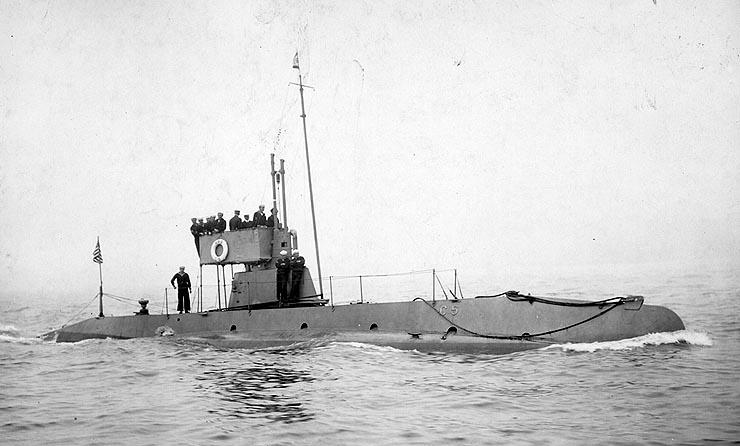
The USS C-5 (SS-16), originally known as "Submarine No. 16," was a notable vessel in the early 20th-century U.S. Navy, representing the evolution of American submarines. As a C-class submarine, she measured 105 feet 3 inches (32.08 meters) in overall length, with a beam of 13 feet 10 inches (4.22 meters) and a mean draft of 10 feet 10 inches (3.30 meters). Displacing 238 long tons (242 metric tons) on the surface and 275 long tons (279 metric tons) submerged, she was capable of diving to depths of 200 feet (61 meters). Her crew comprised one officer and fourteen enlisted men. The C-5 was powered on the surface by two Craig gasoline engines, each producing 240 brake horsepower, driving separate propeller shafts. When submerged, she relied on electric motors of 115 horsepower each. Her maximum surface speed was approximately 11 knots (20 km/h), while her submerged speed was around 9 knots (17 km/h). Her operational range was 776 nautical miles (1,437 km) at 8.13 knots on the surface, with a submerged range of 24 nautical miles (44 km) at 8 knots. Constructed by Fore River Shipbuilding Company in Quincy, Massachusetts, under subcontract from Electric Boat, she was laid down on March 17, 1908, launched on June 16, 1909, and commissioned on February 2, 1910. Her commissioning commander was Ensign Chester W. Nimitz. After fitting out at Boston Navy Yard, she underwent extensive training and experimentation along the U.S. East Coast, including tests of radio communication, submarine signaling, and battery technology, many of which contributed to standard practices in later submarines. Renamed C-5 on November 17, 1911, she participated in fleet maneuvers and helped develop submerged attack tactics, while also engaging in early naval aviation exercises. In May 1913, she departed Norfolk in tow for Guantánamo Bay, Cuba, where she conducted torpedo drills and exercises in Cuban waters. Later, she sailed under her own power to the Panama Canal Zone, where she operated in Panamanian waters, performing exercises and harbor defense patrols, and assessing potential submarine base sites. C-5 was decommissioned at Coco Solo in December 1919 and sold in April 1920. Her service marked important advances in submarine design, tactics, and technology, including the use of gasoline engines built by James Craig, whose engineering expertise was highly regarded by figures such as Fleet Admiral Chester Nimitz.
This description has been generated using GPT-4.1-NANO based on the Vessel's wikidata information and then modified by ShipIndex.org staff.