
USS Canonicus
1863 Canonicus-class monitor
Vessel Wikidata
* This information from Wikidata is available under the Creative Commons Attribution-ShareAlike License
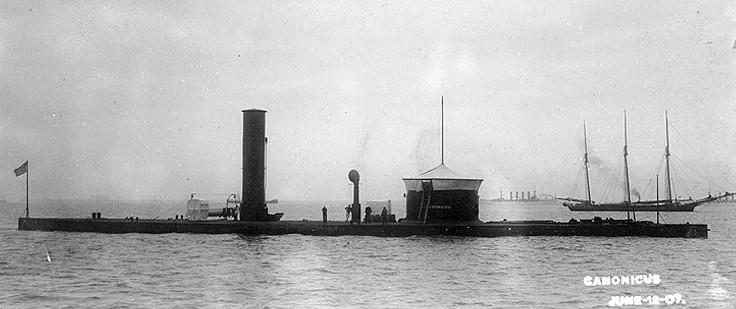
The USS Canonicus was a single-turret monitor built during the American Civil War, serving as the lead ship of her class. She measured 224 feet in overall length, with a beam of 43 feet 4 inches and a maximum draft of 13 feet 6 inches. Displacing approximately 2,100 long tons, she was powered by a two-cylinder Ericsson vibrating-lever steam engine that drove a single propeller, achieving a top speed of about 8 knots. Her armament consisted of two massive 15-inch Dahlgren muzzle-loading guns mounted in a revolving turret, capable of firing shells weighing around 350 pounds up to 2,100 yards. Constructed at Harrison Loring’s Boston shipyard, the USS Canonicus was launched on August 1, 1863, and commissioned on April 16, 1864. Her construction involved several modifications, including increased armor thickness on the turret and pilot house, hull deepening, and deck armor replacement, reflecting battle experience with earlier monitors. Her armor protection included five layers of 1-inch wrought iron plates on the hull sides backed by wood, ten layers of 1-inch plates on the turret and pilot house, and 1.5-inch deck armor. Additional features included a 1/2-inch armor "rifle screen" atop the turret for crew protection. During her service, Canonicus primarily operated on the James River, supporting Union forces during the Bermuda Hundred Campaign. She engaged Confederate artillery batteries and participated in the duels at Howlett's Farm, firing numerous shells without significant damage or casualties. Later, she was reassigned to the North Atlantic Blockading Squadron, playing a prominent role in the First and Second Battles of Fort Fisher, firing hundreds of shells against Confederate fortifications and dismounting enemy guns. Post-war, Canonicus served in the South Atlantic Squadron, capturing a blockade runner and visiting Havana, Cuba—becoming one of the first U.S. ironclads to visit a foreign port. She was decommissioned in 1877, renamed briefly Scylla in 1869, and later recommissioned in 1872 for coastal patrols. The vessel was displayed at the 1907 Jamestown Exposition before being sold for scrap in 1908. Her service history highlights her importance as an early ironclad vessel during the Civil War and her role in maritime innovation and blockade enforcement.
This description has been generated using GPT-4.1-NANO based on the Vessel's wikidata information and then modified by ShipIndex.org staff.