
USS Lanikai
Vessel Wikidata
* This information from Wikidata is available under the Creative Commons Attribution-ShareAlike License
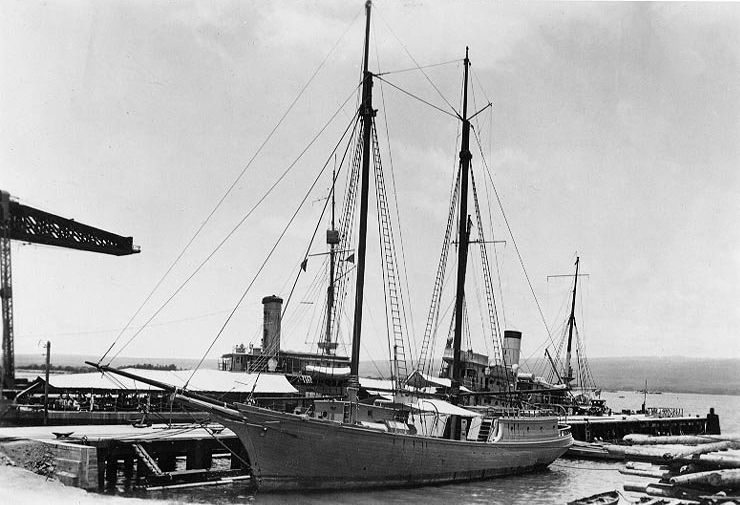
The USS Lanikai was originally built as MY Hermes in 1914 by W. F. Stone of Oakland, California. She features a wooden hull and was rigged as a schooner, powered by diesel engines, making her a yacht of notable versatility. As built, she served the Williams-Diamond Company for German trading interests, specifically for the Jaluit-Gesellschaft of Hamburg. During World War I, after the United States entered the conflict in April 1917, she was taken over by the U.S. Navy and commissioned at Honolulu as USS Hermes on April 1, 1918. Her initial role was as a submarine patrol vessel operating out of Honolulu. She conducted patrols, including a cruise among the northwest Hawaiian islands to search for shipwreck survivors, enemy activity, and to survey wildlife for the Biological Survey Commission. After her patrol duties, she was decommissioned in January 1919 and repurposed as a tender for leper colonies, later serving as a store ship and auxiliary craft. In 1926, she was sold to the Lanikai Fish Company and renamed Lanikai, subsequently changing ownership multiple times, including a stint with Metro-Goldwyn-Mayer studios for film production. In 1941, she was acquired by the U.S. Navy in the Philippines but was never officially commissioned. During the early days of World War II, she played a strategic role in patrolling approaches to Manila Bay and was involved in evacuations during the Japanese attack. Lanikai's most notable service was during the late 1941 and early 1942 period, when she was chartered to gather intelligence on Japanese movements. She participated in the evacuation of Manila and attempted to escape to the Netherlands East Indies, navigating through dangerous waters and evading Japanese forces. Her voyage from Mariveles Bay to Fremantle, Australia, lasted 82 days, showcasing her endurance and seaworthiness. After arriving in Australia, she served in harbor defense under the Royal Australian Navy for the remainder of World War II. Post-war, she was returned to her owner in Manila but was in poor condition. While being repaired in 1947 at Subic Bay, she sank during a typhoon. Her wreck was rediscovered in 2003 off Nabasan Wharf, with artifacts later salvaged, marking her as a vessel of considerable wartime significance and resilience.
This description has been generated using GPT-4.1-NANO based on the Vessel's wikidata information and then modified by ShipIndex.org staff.