
USS Long Beach
United Kingdom cargo ship
Vessel Wikidata
* This information from Wikidata is available under the Creative Commons Attribution-ShareAlike License
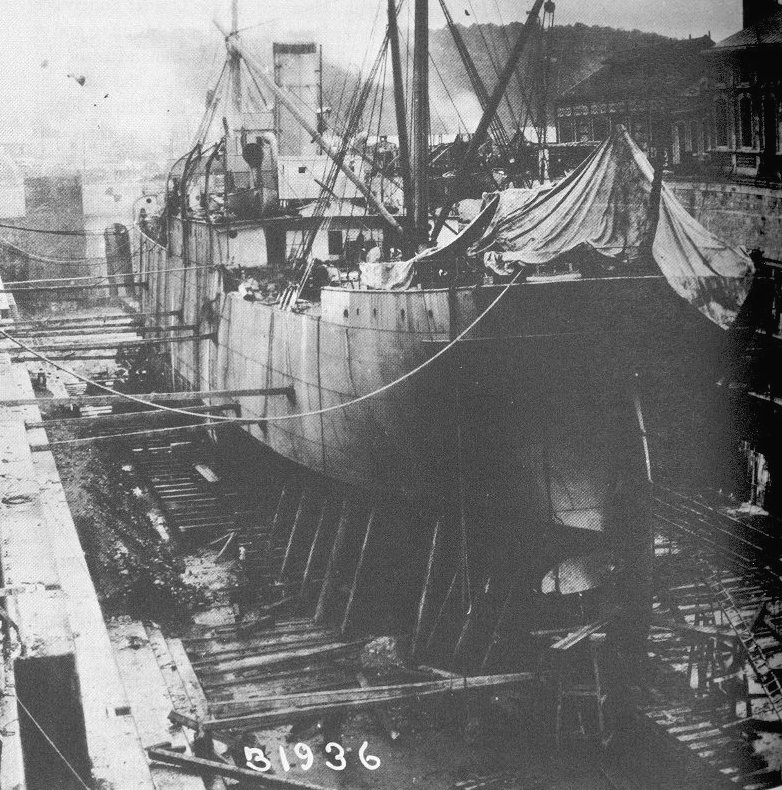
The USS Long Beach (AK-9) was originally built as a cargo steamship in England in 1892, designated Yarrowdale. Constructed by William Pickersgill & Sons at Southwick, Sunderland, she was launched on October 5 and completed in November of that year. The vessel measured 320.1 feet (97.6 meters) in length, with a beam of 41.4 feet (12.6 meters) and a depth of 21.2 feet (6.5 meters). Her tonnage was 2,980 gross register tons (GRT), with a net tonnage of 1,908 NRT, and a displacement of approximately 5,800 tons. Power was provided by a three-cylinder triple expansion steam engine built by George Clark Ltd, rated at 265 NHP, enabling her to reach a speed of about 8.5 knots. Initially owned by the Mackill Steamship Company and managed by Robert Mackill & Co., she was registered in Glasgow with the UK official number 99857 and the code letters MVBN. Throughout her early career, she changed ownership and names: in 1902, she was acquired by CN Castriotti and renamed Nicolaos Castriotis, registered in Piraeus; and in 1905, she was purchased by D Fuhrmann, Nissle und Günther Nachfolger, renamed Hohenfelde, and registered in Hamburg. By August 1914, she had taken refuge in Savannah, Georgia, amidst the outbreak of World War I. Following the United States' entry into the war in April 1917, the US Shipping Board seized Hohenfelde in Savannah and transferred her to the U.S. Navy, commissioning her on December 20, 1917, as USS Long Beach (ID-2136). She served as a cargo vessel, initially transporting lumber from Jacksonville to Philadelphia, then carrying coal and other supplies across the Atlantic to Ireland and France as part of the Army Cross Channel Service. Her duties included transporting aviation materials and supporting U.S. military operations in Europe. After the war, USS Long Beach continued service with the Naval Overseas Transportation Service, delivering coal and supplies to various U.S. ports and the West Indies. She was redesignated AK-9 on July 17, 1920, before being decommissioned at Boston Navy Yard in April 1921. Post-military service, she was fitted with wireless telegraphy and sold twice, becoming Nicolaos Castriotis, then Hohenfelde, and finally Golden Gate. Her maritime career ended when she was scrapped in Genoa, Italy, in October 1924, marking her as a vessel of notable service through wartime and commercial phases.
This description has been generated using GPT-4.1-NANO based on the Vessel's wikidata information and then modified by ShipIndex.org staff.