
USS Montauk
1862 Passaic-class monitor
Vessel Wikidata
* This information from Wikidata is available under the Creative Commons Attribution-ShareAlike License
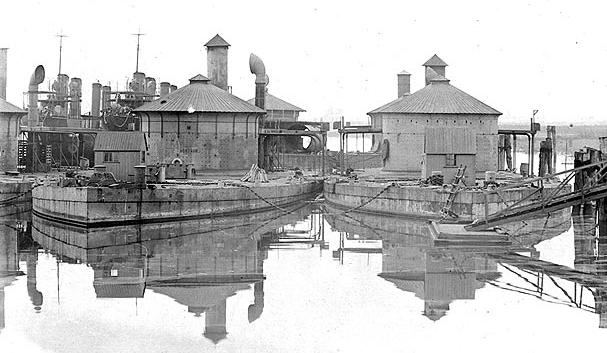
The USS Montauk was a Passaic-class monitor built for the Union Navy during the American Civil War, representing a significant advancement in naval armor and firepower. Constructed by John Ericsson at Continental Iron Works in Greenpoint, Brooklyn, she was launched on October 9, 1862, and commissioned in New York on December 14, 1862, under the command of Commander John L. Worden. As a single-turreted ironclad, Montauk featured the distinctive Passaic-class design, which emphasized heavy armor and a revolving gun turret. Throughout her service, Montauk played a vital role in Union naval operations, notably in the naval attack on Charleston, South Carolina. She arrived at Port Royal, South Carolina, in January 1863 to join the South Atlantic Blockading Squadron. The vessel was instrumental in testing the XV-inch Dahlgren gun and her armor during her engagements. On January 27, 1863, she participated in the bombardment of Fort McAllister, Georgia, sustaining hits but remaining undamaged, and subsequently inflicted heavy damage on the fort during a second attack. Montauk also destroyed a blockade runner, Rattlesnake, in the Ogeechee River, though she was damaged by a torpedo (mine) during her operations. In April 1863, Montauk took part in the attack on Charleston, enduring heavy fire and taking 20 hits. She was also involved in the notable attack on Fort Wagner on Morris Island in July 1863, which was crucial for gaining access to Charleston Harbor’s defenses. Under the command of John Dahlgren, the naval forces continued bombardments until the Confederate forces evacuated Fort Wagner in September 1863. Montauk remained in the Charleston area, shifting her operational focus to the Stono River in mid-1864 and later to the Cape Fear River in early 1865. After the war, she served as a floating prison and a repository for the autopsy and identification of Abraham Lincoln’s assassin, John Wilkes Booth, in April 1865. She was decommissioned in Philadelphia the same year and remained there until her sale in 1904. Notably, she briefly served during the Spanish–American War (1898–1899) with a crew of naval reservists tasked with harbor defense at Portland, Maine. The USS Montauk’s service exemplifies the strategic importance of ironclad warships in Civil War naval battles and their enduring maritime significance.
This description has been generated using GPT-4.1-NANO based on the Vessel's wikidata information and then modified by ShipIndex.org staff.