
USS Onondaga
American ironclad river monitor
Vessel Wikidata
* This information from Wikidata is available under the Creative Commons Attribution-ShareAlike License
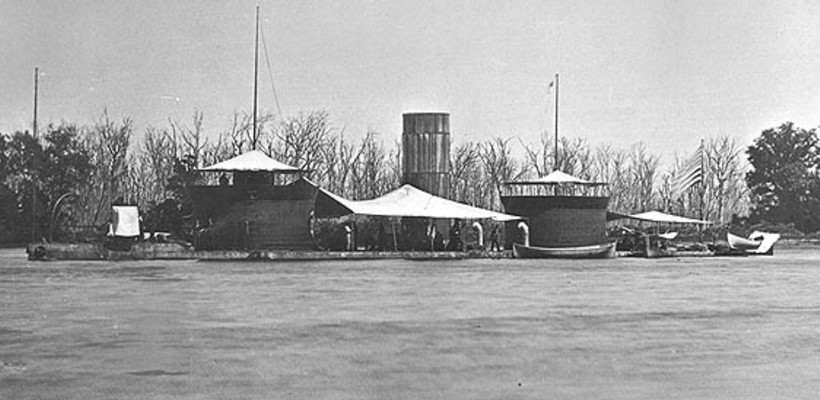
The USS Onondaga was an ironclad monitor constructed during the American Civil War, launched on July 29, 1863, and commissioned in March 1864. Designed by George W. Quintard and built primarily at the Morgan Iron Works with subcontracting to Continental Iron Works, she measured 226 feet in length and had a beam of 51 feet 5 inches. Overweight and with a draft of nearly 12 feet, she displaced approximately 2,592 long tons and had a depth of hold of 12 feet 10 inches. Her crew numbered around 130 officers and enlisted men. Powered by two two-cylinder horizontal back-acting steam engines supplied by four vertical water-tube boilers, Onondaga could reach a speed of 7 knots, with a total indicated horsepower of 642. She carried 160 long tons of coal, giving her a range of 720 nautical miles. Her armament initially consisted of two 15-inch Dahlgren smoothbore guns and two 8-inch Parrott rifles, mounted in twin turrets, with steam-powered mechanisms to rotate them. Her armor included 4.5-inch wrought iron plates on the hull, reinforced by an additional 12 inches of wood and sheathed with a 1-inch armor plate, which increased her draft. The turrets and pilot house were protected by layers of armor up to 11 inches thick, with a soft iron band around the turret bases to prevent jamming. The deck was armored with two layers of 1-inch plates, and her funnel base also received armor protection. During her service in the Union Navy, Onondaga primarily operated with the James River Flotilla, supporting Union efforts around Richmond, Virginia. Her most notable engagement was during the Battle of Trent's Reach in January 1865, where she engaged Confederate ironclads Virginia II and Richmond, damaging Virginia II with her Dahlgren guns. After the Civil War, she was decommissioned and sold to France in 1867, where she served as a coastal defense ship. Her French service included modernization and limited mobilization during the Franco-Prussian War, before being used as a guard ship and eventually scrapped in 1905. The USS Onondaga holds maritime significance as an example of Civil War ironclad design and demonstrates the transition of naval technology from traditional wooden ships to armored steam-powered vessels.
This description has been generated using GPT-4.1-NANO based on the Vessel's wikidata information and then modified by ShipIndex.org staff.