
USS Santiago de Cuba
former US Navy cruiser
Vessel Wikidata
* This information from Wikidata is available under the Creative Commons Attribution-ShareAlike License
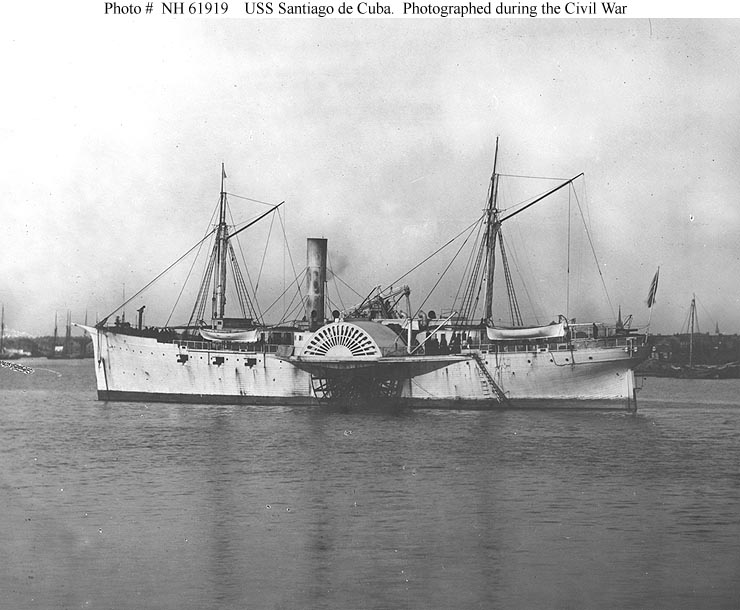
The USS Santiago de Cuba was a notable side-wheel steamship constructed in 1861, primarily serving as a Union Navy gunboat during the American Civil War. Built in Jeremiah Simonson's shipyard in Brooklyn, her hull measured 229 feet in length, with a beam of 38 feet and a depth of 27 feet, displacing approximately 1,567 tons. Her frame was crafted from white oak, hackmatack, and chestnut, reinforced with iron strapping, and she was initially outfitted with a wooden hull. The vessel featured two decks, including accommodations such as 50 first-class staterooms, a dining room, and a lady's salon. Propelled by two side-mounted paddlewheels measuring 29 feet in diameter, she was powered by a walking beam steam engine built by Neptune Iron Works, with a single cylinder of 67 inches in diameter and a 12-foot stroke, supplemented by two coal-fired boilers. Her maximum speed was 14 knots, and she was also brigantine-rigged, capable of sailing under wind power. Commissioned by Valiente & Co. of Cuba and launched on April 2, 1861, Santiago de Cuba was initially intended to operate between New York and Santiago de Cuba. However, shortly after her completion, she was purchased by the U.S. Navy in September 1861 for $200,000 and refitted as a warship, armed with eight 32-pounder carronades and two 20-pounder Parrott rifles. She was commissioned in November 1861 and assigned to the East Gulf Blockading Squadron. During the Civil War, she played a vital role in enforcing the Union blockade, capturing multiple Confederate blockade runners, including the British schooner Victoria and the iron-hulled steamer Columbia, laden with arms and supplies. She participated in significant operations, including the attack on Fort Fisher in 1864-1865, where her crew distinguished themselves, with seven members receiving Medals of Honor for their valor. Following the war, Santiago de Cuba was decommissioned in June 1865 and sold for civilian service. She became a passenger liner, operating on routes such as New York to Nicaragua and Panama, and later as a freight steamer. In 1877, she was converted from paddle-wheel to a propeller-driven vessel at Philadelphia's Neafie and Levy shipyard. Her career included trans-Atlantic crossings, involvement in international trade, and several accidents, including a collision with the steamer Brunette in 1870. By 1886, she was converted into a schooner barge named Marion for coal transport, which sank after a collision in 1887 but was raised and returned to service. Her ultimate fate remains unknown after her disappearance from federal records in 1899. Her service history underscores her significance as a Civil War-era steamship and a symbol of maritime transition from paddlewheel to screw propulsion.
This description has been generated using GPT-4.1-NANO based on the Vessel's wikidata information and then modified by ShipIndex.org staff.