
SS Kronprinzessin Cecilie
ship
Vessel Wikidata
* This information from Wikidata is available under the Creative Commons Attribution-ShareAlike License
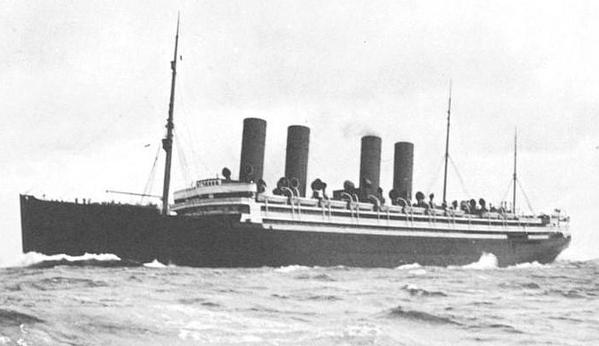
The SS Kronprinzessin Cecilie was a German ocean liner launched in 1906 by AG Vulcan Stettin in Stettin, Germany. As the last of four ships in the Kaiser class, she was notable for being the last German liner equipped with four funnels and for having the largest steam reciprocating machinery ever fitted in a ship at the time of her construction. She measured approximately 19,400 gross register tons (GRT), with a length overall of 215.29 meters (706 feet 4 inches) and a beam of 22 meters (72 feet 2 inches). Her propulsion system consisted of four quadruple-expansion steam engines, two per shaft, driving two screw propellers, enabling her to cruise comfortably at 23 knots. The vessel was designed to carry a large complement of passengers, supporting 775 first-class, 343 second-class, and 770 steerage travelers, totaling around 1,888 passengers supported by a crew of 679. The interiors reflected luxury craftsmanship, with gilded metalwork, white surfaces, violet amaranth wood inlays, and ornamented salons. First-class amenities included a smoking room, music and reading rooms, libraries, cafes in the Louis XVI style, and a dining saloon with innovative round tables and an à la carte menu, a novelty at the time. Kronprinzessin Cecilie served primarily on the transatlantic route between Bremen and New York, operating as a symbol of German maritime prowess amid the competition with the United Kingdom. She had a notable maiden voyage delayed by sinking in Bremerhaven harbor in July 1907, but she was repaired and resumed service. During her peacetime career, she was popular for her luxurious interiors and modern amenities, including a fish tank and private suites. With the outbreak of World War I, she was at sea returning from New York when she was diverted to the United States, where she was interned in Maine. After the U.S. entered the war, she was seized, renamed USS Mount Vernon, and commissioned into the U.S. Navy as a troop transport. During her naval service, she made nine voyages transporting American troops to Europe, notably surviving a torpedo attack in September 1918 that damaged her but did not sink her. Post-war, she was used for repatriation missions and later transferred to the Army Transport Service, making trips to Russia and Germany. She was ultimately scrapped in 1940, marking the end of her distinguished maritime history.
This description has been generated using GPT-4.1-NANO based on the Vessel's wikidata information and then modified by ShipIndex.org staff.