
Japanese cruiser Chiyoda
Japanese cruiser
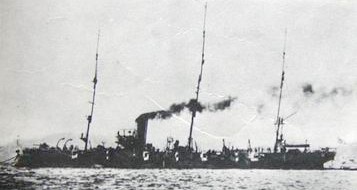
Vessel Wikidata
* This information from Wikidata is available under the Creative Commons Attribution-ShareAlike License
The Japanese cruiser Chiyoda was an armored cruiser of the Imperial Japanese Navy, constructed in Glasgow, Scotland, and commissioned in 1891. Its design was based on a scaled-down version of the Royal Navy's Nelson-class cruisers, featuring a hull with 84 watertight compartments protected by Harvey armor. Initially intended to carry 12.6-inch Canet guns, the design was altered to accommodate ten QF 4.7-inch /40 naval guns, mounted singly along the bow, stern, and sides in sponsons. This armament benefited from Elwick quick-firing technology, significantly increasing the rate of fire. The secondary battery included 14 QF 3-pounder Hotchkiss guns, three 11-mm Nordenfelt guns, and three 356 mm Whitehead torpedo tubes on the main deck. The ship's prow was reinforced for ramming, a common feature of the period. Throughout its service, Chiyoda participated in numerous conflicts, including the First Sino-Japanese War, Russo-Japanese War, and World War I. During the Sino-Japanese War, she patrolled Korea, China, and Russia, and was present at key battles such as the Battle of Yalu River and the Battle of Weihaiwei. She also took part in the invasion of Taiwan and the bombardment of Chinese coastal forts at Keelung in 1895. Post-war, she underwent modernization at Kure Naval Arsenal, replacing her triple expansion steam engines’ boilers with Belleville boilers and removing her fighting tops for stability. During the Russo-Japanese War, she notably participated in the Battle of Chemulpo Bay, the Battle of the Yellow Sea, and the Battle off Ulsan, and was damaged by a Russian mine but repaired in Dalian to continue fighting at Tsushima. Reclassified as a 2nd-class coastal defense vessel in 1912, Chiyoda served in World War I during the Siege of Tsingtao and patrolled Chinese coasts. Later, she was downgraded to a destroyer tender and used for various auxiliary roles, including training. She was decommissioned in 1927 and sunk as a target during live fire exercises by the cruiser Furutaka. The ship's bridge was preserved at the Imperial Japanese Naval Academy as a parade review stand, marking her maritime significance as a versatile and active vessel through multiple conflicts.
This description has been generated using GPT-4.1-NANO based on the Vessel's wikidata information and then modified by ShipIndex.org staff.