
HMS Natal
1905 Warrior-class armoured cruiser
Vessel Wikidata
* This information from Wikidata is available under the Creative Commons Attribution-ShareAlike License
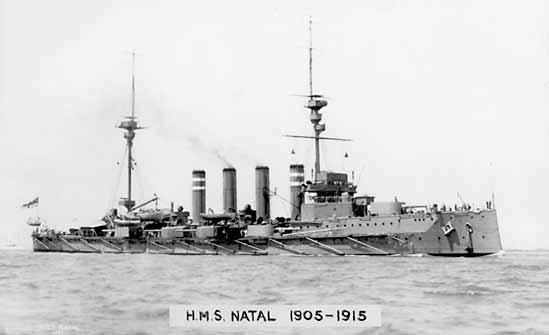
HMS Natal was a Warrior-class armoured cruiser built for the Royal Navy in the early 20th century, representing a significant example of pre-World War I naval design. Displacing approximately 13,550 long tons (13,770 tonnes) at standard load and up to 14,500 long tons (14,700 tonnes) when fully loaded, she measured 505 feet 4 inches (154.0 meters) in length, with a beam of 73 feet 6 inches (22.4 meters) and a draught of 27 feet 6 inches (8.4 meters). Her propulsion system consisted of four-cylinder triple-expansion steam engines driving two shafts, producing 23,650 indicated horsepower, and capable of reaching a maximum speed of 23.3 knots (43.2 km/h). The ship was powered by 19 Yarrow water-tube boilers alongside six cylindrical boilers, carrying a maximum of 2,050 long tons (2,080 tonnes) of coal and 600 long tons (610 tonnes) of fuel oil, which was sprayed onto the coal to improve combustion. This enabled a cruising range of 7,960 nautical miles (14,740 km) at 10 knots. Her armament comprised six BL 9.2-inch (234 mm) Mark X guns in two centerline turrets (fore and aft) and four in corner turrets, providing substantial firepower. Additionally, she was armed with four BL 7.5-inch (191 mm) guns amidships, and twenty-six Vickers QF 3-pounder guns. Natal also carried three submerged 18-inch (450 mm) torpedo tubes, including one in the stern. Her design featured the stability advantages of turreted secondary guns, making her a steady gun platform on the high seas. Constructed by Vickers at Barrow-in-Furness, she was laid down in January 1904, launched in September 1905, and completed in March 1907 at a cost of over £1.2 million. Named after the Colony of Natal, her service included escorting the royal yacht during King George V’s 1911–1912 trip to India and transporting the U.S. Ambassador’s body in 1912. During World War I, she served with the Grand Fleet’s 2nd Cruiser Squadron but saw no major battles. Tragically, on 30 December 1915, Natal was lost near Cromarty due to an internal explosion, likely caused by faulty cordite in her magazines, resulting in at least 390 fatalities. Her wreck was gradually salvaged, with the remainder blown up in the 1970s to prevent navigation hazards. Today, her remains are designated as a controlled war grave under the Protection of Military Remains Act 1986, commemorating her service and the lives lost.
This description has been generated using GPT-4.1-NANO based on the Vessel's wikidata information and then modified by ShipIndex.org staff.