
USS Washington
1940 North Carolina-class battleship
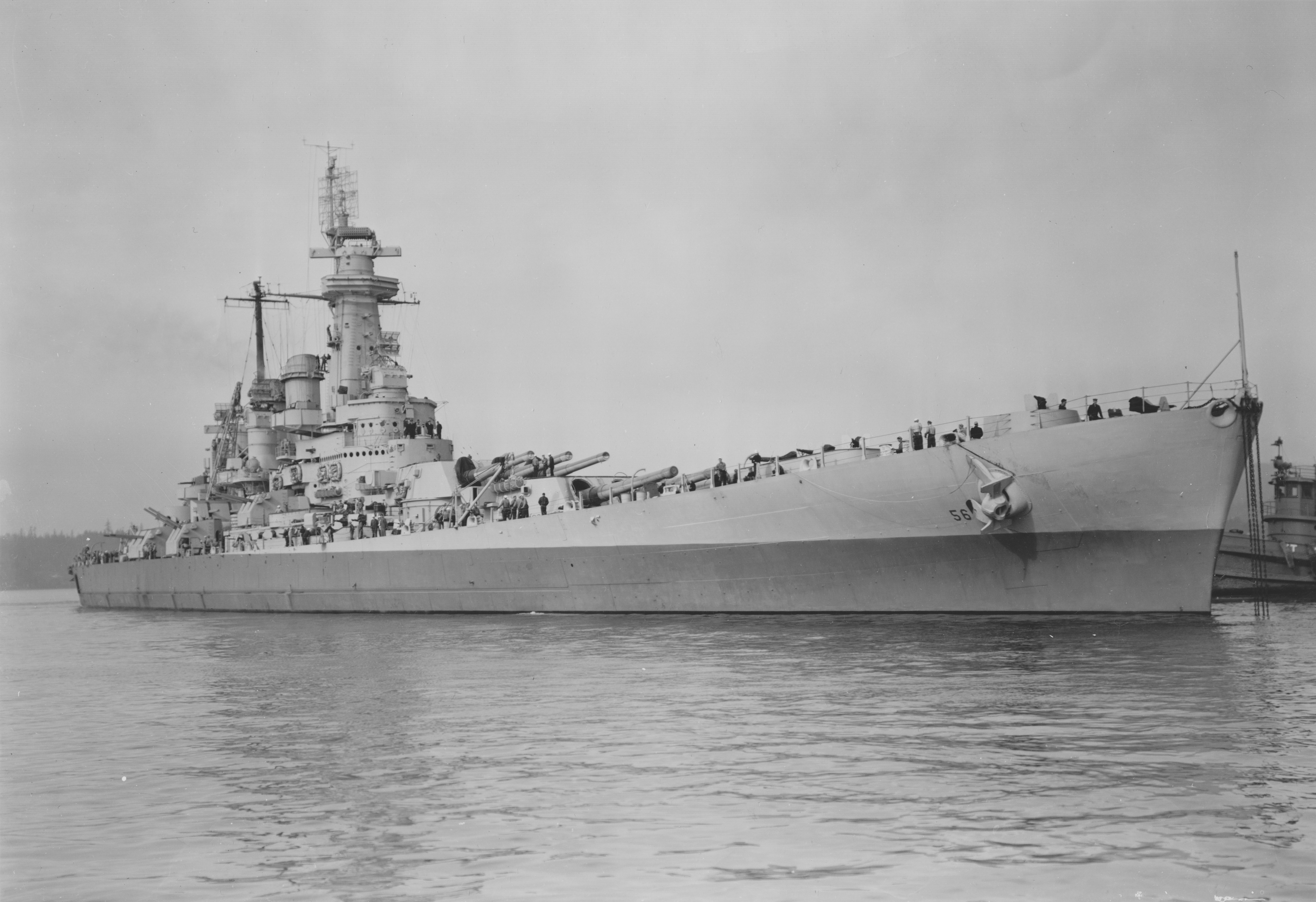
Vessel Wikidata
* This information from Wikidata is available under the Creative Commons Attribution-ShareAlike License
The USS Washington (BB-56) was a North Carolina-class fast battleship and the first U.S. battleship to be armed with 16-inch guns, a result of the U.S. exploiting a clause in the Second London Naval Treaty. Laid down in 1938 at the Philadelphia Naval Shipyard and launched in 1940, she was commissioned in May 1941, just prior to the U.S. entry into World War II. Her overall length was approximately 728 feet 9 inches, with a beam of 108 feet 4 inches and a draft of 32 feet 11.5 inches. Displacing 35,000 long tons standard and up to 44,800 long tons at full load, she was powered by four General Electric steam turbines generating 121,000 shaft horsepower, designed for a top speed of 28 knots, though vibration issues hampered her high-speed performance. Washington's main armament consisted of nine 16-inch/45 caliber Mark 6 guns in three triple turrets, and her secondary battery comprised twenty 5-inch/38 caliber dual-purpose guns. Her armor included a 12-inch belt, up to 5.5-inch deck armor, and 16-inch faces on her main turrets, designed primarily against 14-inch guns. Throughout her service, she received extensive radar and anti-aircraft upgrades, expanding her battery from initial configurations to include numerous 40mm Bofors and 20mm Oerlikon guns. Initially assigned to the Atlantic Fleet, Washington was deployed to Britain in 1942 to reinforce the Home Fleet, but was soon transferred to the Pacific Theater. She played a pivotal role in the Guadalcanal campaign, notably during the Naval Battle of Guadalcanal in November 1942, where she inflicted critical damage on Japanese ships, including the battleship Kirishima. Washington participated extensively in Pacific operations, screening carrier task forces, supporting amphibious assaults, and engaging in major battles such as the Mariana campaign, the Battle of the Philippine Sea, and the Battle of Leyte Gulf. Her combat record demonstrated her effectiveness in night engagements and fleet actions. After the war, Washington supported Operation Magic Carpet, transporting troops back to the U.S., before being decommissioned in 1947. She was placed in reserve, with considerations for modernization that were ultimately deemed cost-prohibitive. The vessel was stricken from the naval register in 1960 and sold for scrap in 1961. Her service exemplified the evolution of U.S. battleship design and her active participation in key naval battles established her as a significant asset in the Pacific theater during World War II.
This description has been generated using GPT-4.1-NANO based on the Vessel's wikidata information and then modified by ShipIndex.org staff.